Scientists explore complex metal-support interactions under redox conditions using our Climate system

Scientists explore complex metal-support interactions under redox conditions using our Climate system

Via the DENSsolutions Climate system, a team of scientists uncover the dynamic interplay between platinum nanoparticles and titania support under reaction conditions.

Original article by H. Frey, A. Beck, X. Huang, J.A. van Bokhoven and M. G. Willinger

For catalysts consisting of metal nanoparticles and an oxide support, understanding the synergistic reactions between the metal and support is paramount. In the case of reducible supports, the so-called strong metal-support interaction (SMSI) provides a means of tuning the chemisorption and catalytic properties of supported metal particles. SMSI involves the encapsulation of nanoparticles by a thin layer of partially reduced support material. The encapsulation is typically induced during high-temperature reductive “activation”, i.e., treatment in hydrogen. Notably, the direct imaging of this encapsulated state has mostly been achieved ex situ. Little is known about SMSI under catalytic working conditions, where the application of in situ electron microscopy is invaluable. While environmental transmission electron microscopy (TEM) is generally limited to chamber pressures of around 20 mbar, the DENSsolutions Climate Nano-Reactor can handle pressures 100 times higher, unlocking unprecedented research possibilities for the study of catalysts in their native environment.

In recent research performed at ScopeM, ETH Zurich, where our advanced Climate G+ system is installed, Hannes Frey, Arik Beck, Dr. Xing Huang, Prof. Dr. Jeroen Anton van Bokhoven and Prof. Dr. Marc Georg Willinger investigated the dynamic interplay between metal nanoparticles and oxide support under reaction conditions. More specifically, the scientists revealed the working state of a model catalyst, Pt–TiO, by directly observing the synergistic interactions related to SMSI between the platinum nanoparticles and titania support.

Switching to a redox-active H₂–O₂ mixture

Frey and his fellow collaborators first induced the classical SMSI state by heating the titania-supported platinum nanoparticles (NPs) in H₂. The nanoparticles were then transferred into an O₂ atmosphere via inert gas purging. Interestingly, this treatment resulted in the platinum NPs incurring a nonclassical oxidized SMSI state. After preparing the system, the researchers then exposed it to a redox active atmosphere through the addition of H₂ into the O₂ flow. With the Climate G+ system, the researchers were able to mix the gasses on the fly, while continuing with the high-resolution observation. 

In Figure 1 and Movie 1 below, the morphological change of the platinum NPs upon transition into the redox-active regime is presented. Increasing the partial pressure of H₂ in the Climate Nano-Reactor resulted in the gradual change in the encapsulated state of the Pt NPs. Moreover, this resulted in the ultimate disappearance of the overlayer as soon as the gas composition reached a set mixture of 60 mbar H₂ and 700 mbar O₂ after ~180 s. Once the overlayer was fully removed, the particle was observed to experience particle dynamics like restructuring and migration (shown in Figure 1E and 1F). 

Figure 1: Image series depicting the morphological changes observed when a titania-supported platinum nanoparticle in a nonclassical SMSI state is exposed to a redox-active atmosphere. The composition of the gas in the Nano-Reactor was gradually changed from 700 mbar O₂ to a mixture of 60 mbar H₂ plus 700 mbar O₂. t0 is the time at which the H₂ flow was turned on.

Movie 1: TEM Movie depicting the morphological changes observed when a titania-supported platinum nanoparticle in a nonclassical SMSI state is exposed to a redox-active atmosphere.

Particle and interfacial dynamics in the redox-active regime

The researchers then set out to explore the response of a collection of nanoparticles to reaction conditions. They discovered that the degree of structural dynamics and mobility differed greatly among the nanoparticles. Whereas some NPs remained static and stationary, others incurred structural fluctuations and migrated across the substrate surface. The researchers decided to follow three representative cases of nanoparticles with different orientations. In all cases, it is observed that the redox chemistry at the interface is the driving force for particle reconstruction and migration. In Figure 2 below, the respective structural dynamics of the three selected nanoparticles are presented.

Figure 2: (A–C) Pt NP oriented with (111) planes perpendicular to the interface. (G to J) Pt NP oriented with (111) planes parallel to the interface. (K to N) Pt NP that has its (111) planes inclined toward the interface. The blue shapes indicate the respective positions of the Pt NP in the previous frames.

Case 1

The first platinum NP that was considered was oriented with (111) planes perpendicular to the interface. In Movie 2 below, the recorded time series of this platinum NP at 600°C in an atmosphere containing 700 mbar O₂ plus 60 mbar H₂ is shown. Here, the NP developed pronounced structural dynamics that involved twin formation and shearing along (111) planes in an up-down motion, perpendicular to the interface. 

Movie 2: Recorded time series of the Pt NP presented in Figure 2A–C) at 600°C in an atmosphere containing 700 mbar O₂ plus 60 mbar H₂.

Case 2

The second Pt NP that was considered was oriented with (111) planes parallel to the interface. Movie 3 below shows the image series acquired for this nanoparticle, at 600°C in an atmosphere containing 700 mbar O₂ plus 60 mbar H₂. Here, a continuous step flow motion of the (111)-type facet in contact with the interface is observed.

Movie 3: Image series of the Pt NP presented in Figure 2G–J) at 600°C in an atmosphere containing 700 mbar O₂ plus 60 mbar H₂.

Case 3

The third platinum NP that was considered was oriented with (111) planes inclined towards the interface. Movie 4 below shows the image series acquired for this nanoparticle, at 600°C in an atmosphere containing 700 mbar O₂ plus 60 mbar H₂. In this case, the nanoparticle is observed to engage in redox chemistry-driven directional surface migration which is caused by restructuring at the interface.

Movie 4: Image series of the Pt NP presented in Figure 2K–N) at 600°C in an atmosphere containing 700 mbar O₂ plus 60 mbar H₂.

Retraction of H₂ and reformation of the oxidic SMSI overlayer

The next step for Frey and his fellow researchers was to switch the gas composition from a reactive feed back to a purely oxidizing environment by turning off the H₂ flow. This change in the gas composition resulted in the encapsulated state of the platinum NPs to be reestablished. In Figure 3 below, the morphological change of a Pt NP upon switching the gas from a redox-active environment to a purely oxidizing environment is presented. This switching of the gas composition led to the reformation of a classical particle overgrowth. It is seen that the nanoparticles first adopted a spherical morphology (Figure 3A–C). Then, as soon as H₂ was fully removed from the Nano-Reactor, the support material migrated onto the Pt NPs and the overlayer reformed (Figure 3D–F).

Figure 3: Image series depicting the morphological changes of a Pt NP observed when switching from a redox-active to purely oxidizing environment at 600°C. t0 is the time at which the H₂ flow was set to zero.

Conclusion

The aim of this paper was to reveal the working state of a catalyst via direct observation and to study possible synergistic interactions related to SMSI between metal nanoparticles and a reducible oxide support. The use of our Climate system enabled the researchers to capture in exceptional detail the dynamic and complex metal-support interactions of Pt–TiO₂ under reactive catalytic conditions. This is especially thanks to the advanced capacity of the system to handle pressures of up to 2 bar. 

A key finding of this paper is that the stable configurations of static Pt particles exhibiting encapsulation were observed to exist either in pure H₂ (the classical SMSI state) or in pure O₂ (the nonclassical SMSI state), but not in an environment where both gases were simultaneously present. Indeed, the exposure to the redox-active environment led to the removal of the overlayer and the subsequent emergence of pronounced particle dynamics. Moreover, the in situ observations show that the particle restructuring and migration behavior is dependent on the relative orientation of the particle on the support, and therefore the configuration of the interface. Overall, these findings advance our comprehension of SMSI-induced encapsulation of metal nanoparticles, which can in turn help us better tune the chemisorption and catalytic properties of catalysts. 

Hanglong Wu portrait

“The DENSsolutions Climate System allows us to reveal the so-far unseen: Looking at not only how the gas-phase is changed in the presence of a catalyst, but also studying how the interaction between gas-phase and catalyst leads to the emergence of catalytic function. Direct real-space observation is essential for our understanding of working catalysts and the development of new processes that are urgently needed in view of climate change and limited natural resources.”

Prof. Dr. Marc-Georg Willinger
Professor  |  Technical University of Munich

Original article:

Discover our Climate solution:

Discover more publications made possible by Climate:
Thomas article feature image

Climate helps uncover phase coexistence and structural dynamics of redox metal catalysts

Using our Climate system, scientists are able to interrelate the atomic-scale structural dynamics of redox metal catalysts to their activity.
Subscribe to our newsletter to stay up-to-date with the latest in situ microscopy news.

Hydrogen vs. syngas: The battle of the reducing gases

Hydrogen vs. syngas: The battle of the reducing gases

Using our Climate system, scientists are able to unveil the most effective method to obtain sintering-resistant metallic cobalt nanoparticles at lower temperatures.

Original article by Ofentse A. Makgae, Tumelo N. Phaahlamohlaka, Benzhen Yao, Manfred E. Schuster, Thomas J. A. Slater, Peter P. Edwards, Neil J. Coville, Emanuela Liberti, and Angus I. Kirkland

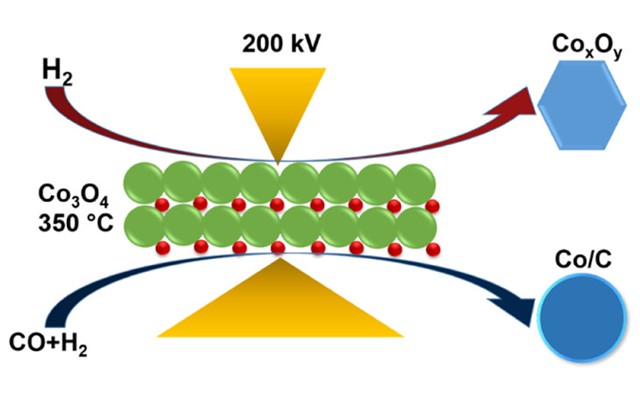
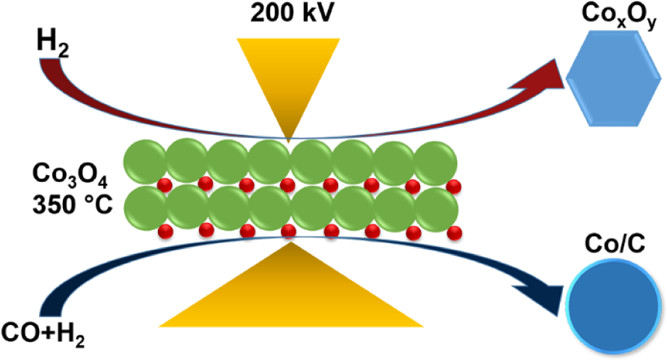
The Fischer-Tropsch synthesis (FTS) is an established catalytic chemical process that occurs when carbon monoxide and hydrogen are converted into hydrocarbons. These hydrocarbons can be further developed into high-quality fuels, lubricants as well as raw materials for the production of plastics, rubbers and industrial chemicals. In FTS, supported cobalt catalysts are commonly used, which are active in their reduced metallic state. Many factors can affect the reduction process of cobalt oxide (Co₃3O₄) to metallic cobalt, including the reduction temperature, the composition of the reducing gas, the catalyst promoter, catalyst support and particle size. Despite this, little is known about the effect of using H₂ versus syngas (H₂ & CO) as the reducing agent on carbon-supported cobalt catalysts.

In recent research performed at the David Cockayne Centre for Electron Microscopy and the electron Physical Science Imaging Centre (ePSIC), a number of scientists from highly renowned universities and institutes, including University of Oxford, Johnson Matthey, Diamond Light Source and Cardiff University, investigate the atomic structure and valence state of cobalt nanocrystals on carbon supports under syngas versus hydrogen reduction. Specifically, using ex situ and in situ high-resolution aberration-corrected analytical electron microscopy with our Climate system, the researchers were able to explore the effect of H₂ versus syngas (H₂ & CO) on the reducibility of cobalt oxide nanoparticles supported on hollow carbon spheres. By uncovering highly effective methods to obtain sintering-resistant metallic Co nanoparticles at lower temperatures on hollow carbon sphere supports, this work provides valuable insights that can inform important industrial processes.

Synthesis and reduction of cobalt oxide

Dr. Ofenste Makgae and his fellow collaborators first synthesized the Co₃3O₄ nanoparticles before preparing the hollow carbon sphere supports (HCSs). The synthesized Co₃3O₄ nanoparticles were then loaded on the surface of the HCSs to prepare the precursor catalyst.

The researchers then initiated the reduction process of the Co₃3O₄ nanoparticles for both the ex situ and in situ analysis. For the ex situ analysis, the precursor was reduced via H₂ and syngas, respectively, at 350 °C at atmospheric pressure for 20 hours. For the in situ analysis, the catalysts were studied using the DENSsolutions Climate system in a probe-corrected JEOL ARM200F at ePSIC operated at 200 kV. Notably, the DENSsolutions Climate system is capable of real-time dynamic mixing of 3 gases over a temperature range from room temperature to 1000 °C. Via the Climate Gas Supply System, Dr. Makgae and his fellow collaborators were able to provide a 0.2mL/min flow of gas at a pressure of 500mbar for both the H₂ and syngas reduction. The temperature was ramped from room temperature to 150 °C under a N₂ flow to remove contaminants. Next, it was ramped to 350 °C at 10 °C/min under a reducing environment. Finally, the temperature was held at 350 °C for 2 hours for catalyst activation.

Ex situ post-reduction morphology analysis

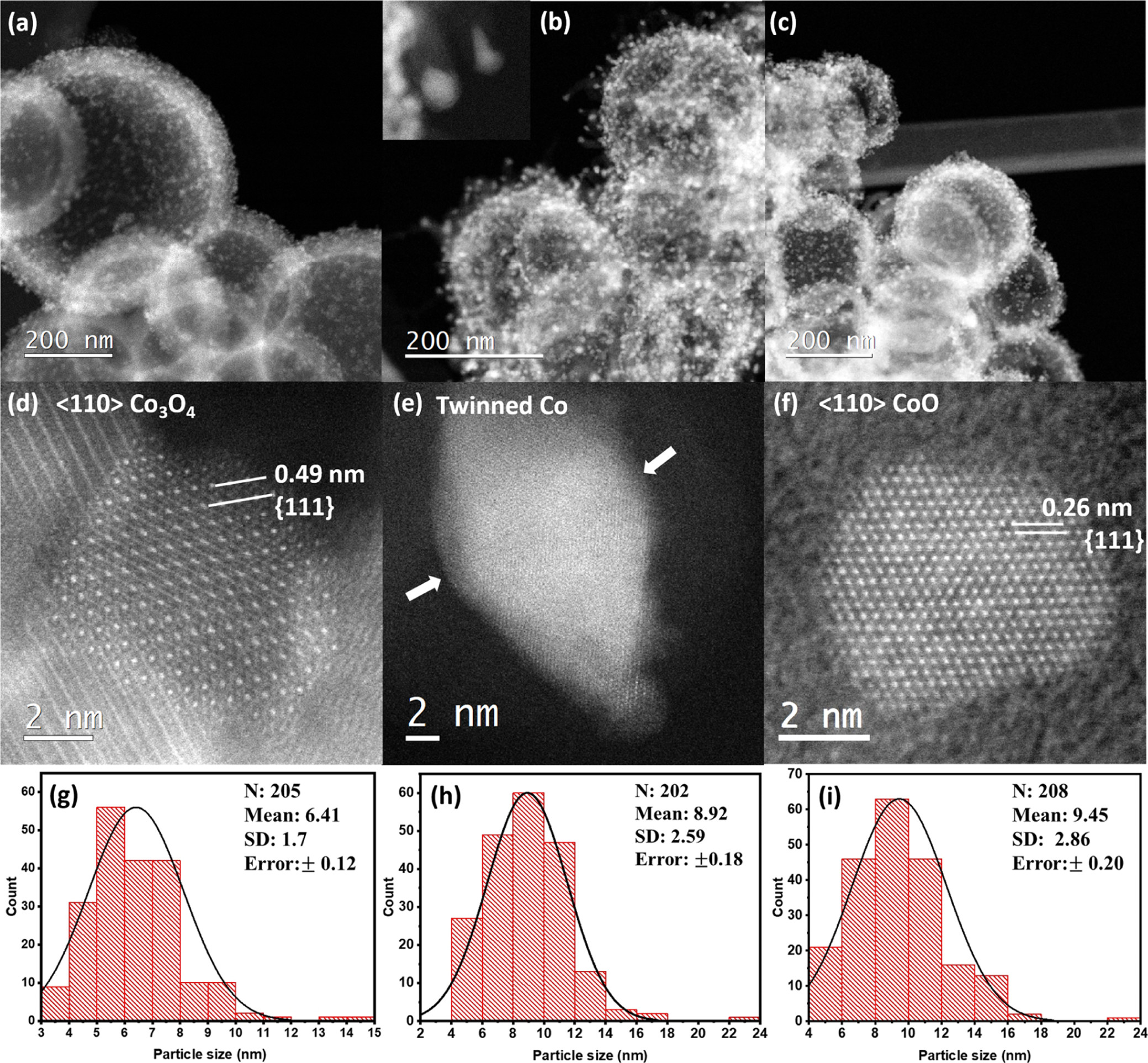
The researchers then set out to analyze the overall morphology of the carbon support post reduction, to ensure that its integrity was not compromised during the reduction process. In Figure 1 below, (high-resolution) STEM-ADF images of the as-prepared Co₃3O₄ and ex situ syngas- and H₂-reduced HCS-supported nanoparticles are shown. The researchers were able to determine that the morphology of the HCSs remained intact after 20 hours of reduction at 350 °C.

Figure 1: STEM–ADF images of the Co nanoparticles (a) before and after the ex situ reduction in (b) syngas (H₂/CO = 2) and (c) H₂ at 350 °C. (d–f) are the corresponding high-resolution STEM–ADF images of the as-prepared Co₃3O₄, syngas-, and H₂-reduced nanoparticles.

EELS spectra and elemental maps

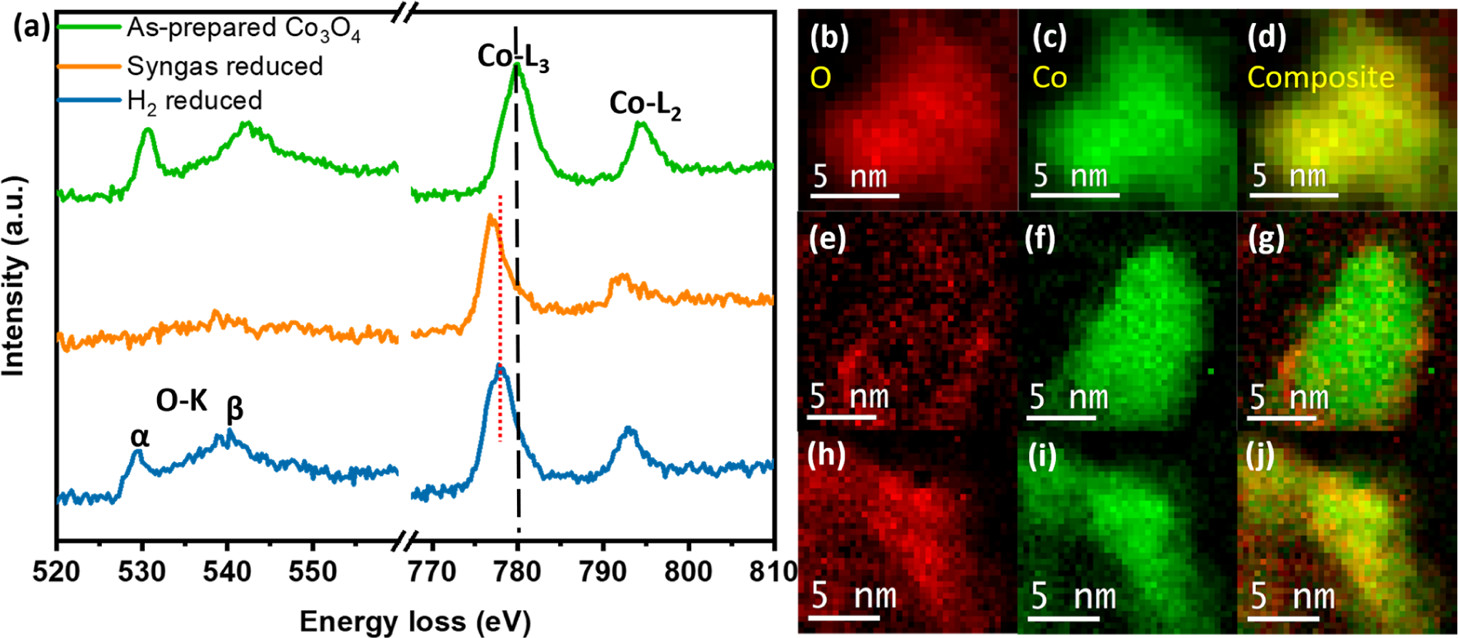
Aside from morphological changes, the oxidation state of cobalt also changes during the reduction process as a function of the reducing gas composition. Using STEM–EELS, the researchers were able to thoroughly investigate the Co-oxidation state changes. Figure 2 below compares the EELS spectra and elemental maps of single particles of the as-prepared Co₃3O₄, and the syngas-reduced and H₂-reduced nanoparticles. Via the EELS spectra analysis, the researchers determined that there was indeed a significant decrease in the oxidation state of Co.

Figure 2: EELS spectra of the as-prepared Co₃3O₄ (green), syngas- (orange), and H₂- (blue) ex situ reduced nanoparticles at 350 °C. EELS elemental maps of (b–d) as-prepared, (e–g) syngas-reduced, and (h–j) H₂-reduced Co₃3O₄ nanoparticles.

Importantly, the EELS spectra observations also show that the degree of reduction varies amongst the two methods (H₂ and syngas). To explore this further, the researchers collected additional spectra to compare the ex situ syngas-reduced and H₂-reduced nanoparticles at 350 °C, with the as-prepared Co₃3O₄ as a reference. From this further analysis, it is observed that the Co in the case of the syngas-reduced nanoparticles’ spectra is in a near-metallic state as compared to the H₂-reduced nanoparticles. These results are consistent with the elemental maps obtained, showing that a more intense Co signal (green) is observed in the elemental map from a syngas-reduced nanoparticle (Figure 2g), compared to a more diffuse Co signal in the elemental map of a H₂-reduced nanoparticle (Figure 2j). Ultimately, in the absence of air surface reoxidation, the results of the in situ STEM–EELS and ADF analysis show that syngas achieves a higher degree of Co reduction than H₂.

High-resolution STEM-ADF analysis

The next step for Dr. Makgae and his collaborators was to perform high-resolution STEM–ADF imaging in order to investigate the differences in the atomic structure associated with the observed differences in Co-oxidation states in the syngas- and H₂-reduced nanoparticles. They explored the reduction of the syngas- and H₂-reduced nanoparticles at two different temperatures, 350 °C and 600 °C.

1) At 350 °C

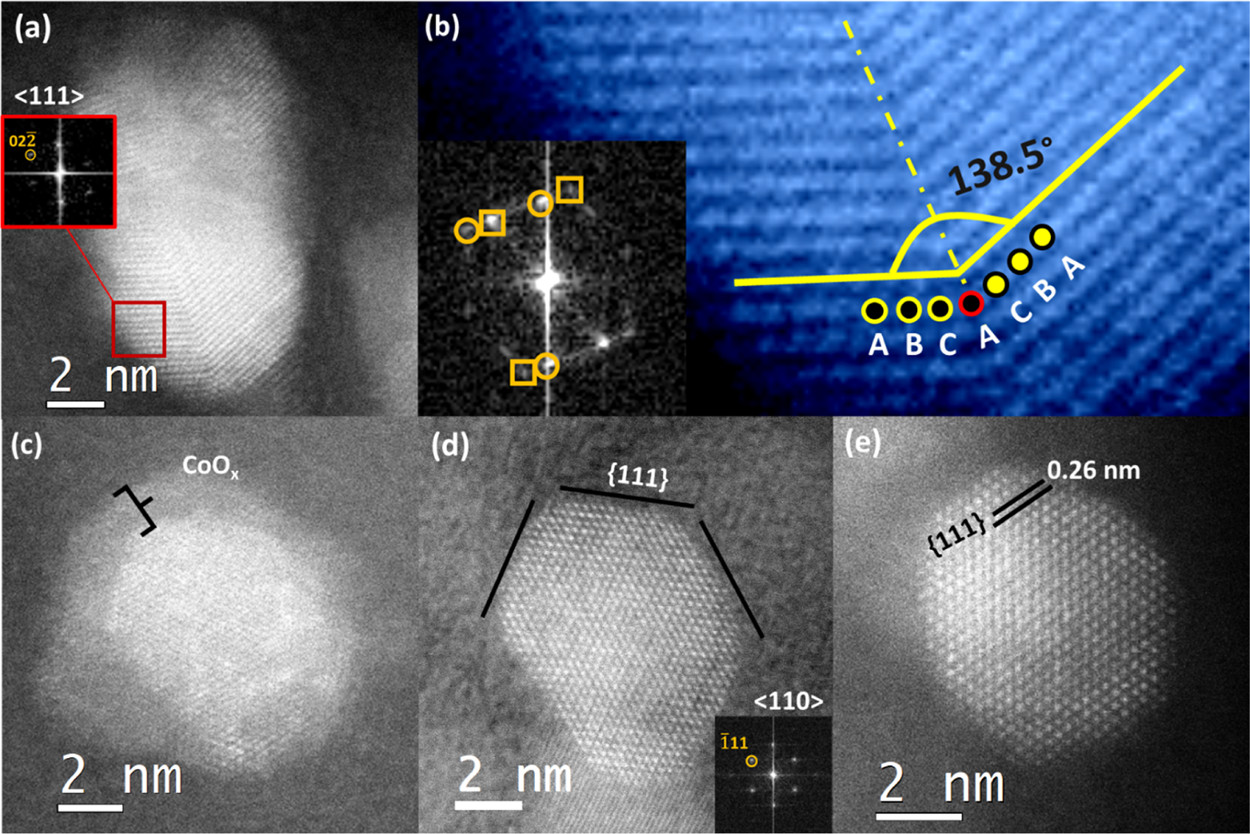
In Figure 3a–e below, the high-resolution STEM–ADF images of syngas-reduced nanoparticles (a–c) and H₂-reduced nanoparticles (d,e) are presented. The results were found to be consistent with the EELS data, showing that syngas reduction produces a majority of metallic Co nanoparticles, whereas H₂ produced particles with a majority of the Co in the 2+ oxidation state. 

Figure 3: High-resolution STEM–ADF images of ex situ (a–c) 350 °C syngas-reduced nanoparticles and (d,e) H₂-reduced nanoparticles.

2) At 600 °C

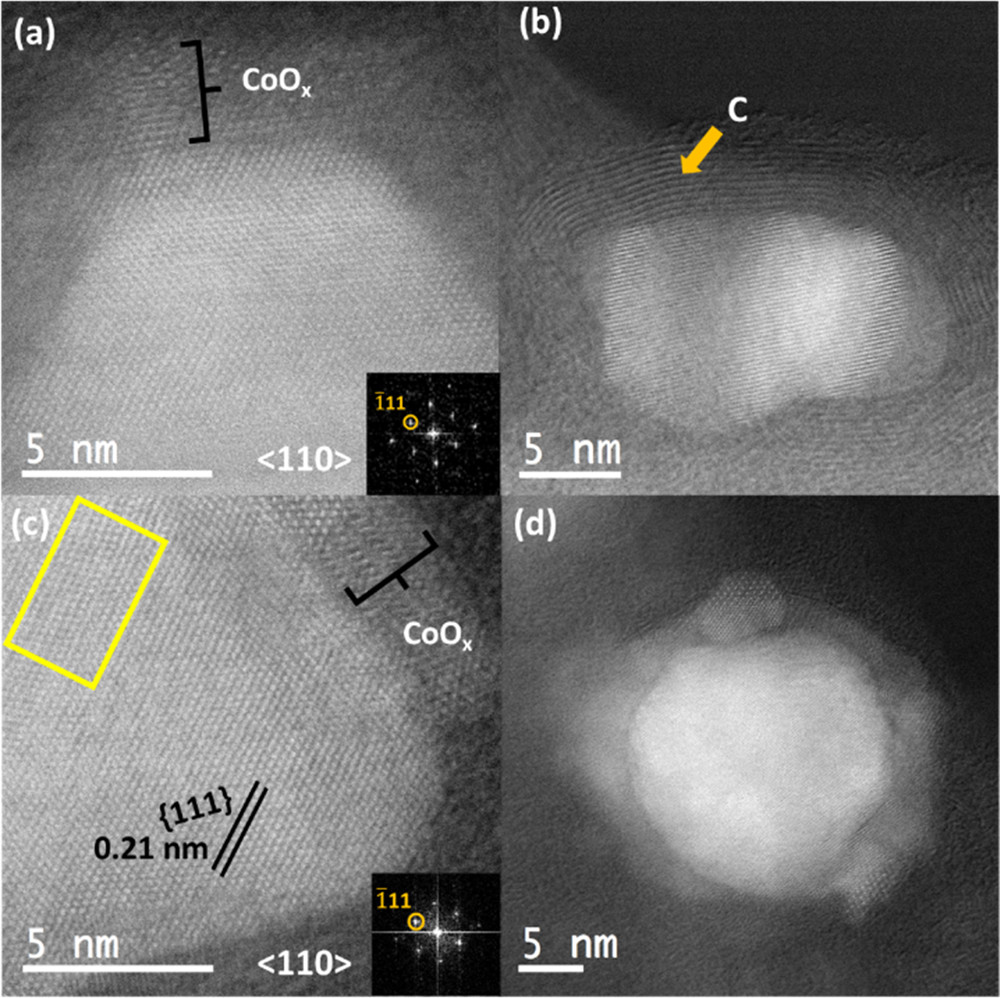
The temperature was then increased to 600 °C to investigate the effect of temperature on reducing HCS-supported Co₃3O₄ nanoparticles under H₂ versus syngas. It is observed that both the H₂- and syngas-reduced nanoparticles exhibit an atomic structure consistent with cobalt (Figure 4a–d). Indeed, the results are consistent with the EELS data from the 600 °C reduced nanoparticles, which shows the presence of metallic cobalt. Conclusively, in order to achieve a complete reduction of Co₃3O₄ under H₂, the HCS-supported nanoparticles must be reduced at high temperatures. Importantly, it is observed that the high temperature of 600 °C resulted in severe sintering of the nanoparticles reduced in H₂ compared to syngas. The sinter-resistance in syngas-reduced nanoparticles is attributed to the encapsulation of nanoparticles with a carbon shell (indicated by the orange arrow in Figure 4b). This encapsulation prevents the coalescence of the nanoparticles at high temperatures. Interestingly, in the case of the H₂-reduced nanoparticles, a carbon shell is not observed (Figure 4d).

Figure 4: High-resolution STEM–ADF images of 600 °C ex situ (a,b) syngas-reduced nanoparticles and (c,d) H₂-reduced Co nanoparticles.

Conclusively, the presence of CO in syngas is observed to play a critical role in the conversion of Co₃3O₄ to metallic Co at 350 °C. In contrast, the full reduction of Co₃3O₄ to active metallic Co in H₂ is not achieved at 350 °C. Increasing the activation temperature to 600 °C does drive the complete reduction, however, significant particle sintering was still observed. Therefore, the presence of CO in a syngas mixture is indeed crucial to achieving complete Co₃3O₄ reduction at 350 °C.

Conclusion

This paper comprehensively illuminates the most effective method to obtain sintering-resistant metallic cobalt nanoparticles at lower temperatures under carbon supports. By conducting a thorough ex situ and in situ electron microscopy analysis using the DENSsolutions Climate system, Dr. Makgae and his fellow collaborators were able to observe under nanometer resolution how the reduction process under H₂ versus syngas affects the physicochemical properties of the reduced nanoparticles. The findings show that syngas achieves a higher reduction at an industrially relevant Fischer-Tropsch reduction temperature of 350 °C compared to H₂ on carbon supports. Importantly, lower reduction temperatures are more efficient as operating costs are reduced, which is a significant consideration for organizations involved in industrial processes. The discovery of such findings could not be possible without the application of in situ electron microscopy techniques, for which our Climate system has proved to be remarkably valuable.

“The DENSsolutions Climate system allowed us to directly evaluate the reducibility of Fischer-Tropsch catalysts under industrially relevant temperatures. Such observations provide a unique insight into the evolution of catalysts under activation conditions.

Dr. Ofentse Makgae
Post-doctoral Research Fellow  |  Lund University

Original article:

Discover our Climate solution:

Discover more publications made possible by Climate:

Thomas article feature image

Climate helps uncover phase coexistence and structural dynamics of redox metal catalysts

Using our Climate system, scientists are able to interrelate the atomic-scale structural dynamics of redox metal catalysts to their activity.
Subscribe to our newsletter to stay up-to-date with the latest in situ microscopy news.

Introducing the Stream Liquid Supply System: An integrated solution offering unmatched flexibility

Introducing the Stream Liquid Supply System: An integrated solution offering unmatched flexibility

An interview with DENSsolutions Mechanical Engineer Alejandro Rozene about our latest addition to the Stream product line: the Liquid Supply System (LSS).

DENSsolutions introduces its latest solution: the Stream Liquid Supply System (LSS): an integrated solution designed to offer you ease-of-use, flexibility and reproducibility in your in situ liquid experiments. In this article, we interview our Mechanical Engineer Alejandro Rozene to learn all about the LSS, from what inspired its development, its unique capabilities and the many applications that will benefit from its creation.

What led to the development of the Stream Liquid Supply System?

“Our Liquid Phase Electron Microscopy (LPEM) solutions have been used by researchers around the world in a plethora of research fields, such as protein studies, battery research and molecular self-assembly. With our Stream system, users can fully control the microfluidic environment inside the Nano-Cell, our environmental MEMS sample carrier, while biasing or heating their sample. Considering the wide range of capabilities the system offers and the complexity of LPEM, Stream is quite the advanced system. This is precisely what inspired the next step in the innovation process: the development of an integrated solution designed to offer greater flexibility and ease-of-use. The Liquid Supply System (LSS) is a single scientific instrument that allows microscopists to carry out imaging experiments in fewer steps while introducing new features. The LSS is also designed to be the basic unit of a modular system that can be configured for different research applications.” 

What are the main benefits of the LSS for users?

“The introduction of the LSS to the Stream product line brings forth numerous advantages for your in situ liquid experiments, including greater flexibility, reliability and reproducibility. These benefits are detailed below:

1) Ease of use: Thanks to the clever architecture of the LSS, particularly the moveable base, you can easily relocate, store and set it up in various locations. It is also possible to control the microfluidic environment of the Nano-Cell and to apply different stimuli using a single interface in Impulse, our in situ experiment control and automation software. All of the sensor data is collected centrally. The LSS therefore simplifies the LPEM workflow and allows you to shift the focus from the hardware to the imaging experiment. This will potentially open the door to more elaborate experimental workflows.

2) High resolution imaging and meaningful analytical analysis: It is widely known that LPEM suffers from limited resolution caused by the thickness of the liquid layer inside the sample chamber. Even a 500 nm liquid layer can limit imaging resolution. With the LSS, the capability of controllable and inert gas purging is introduced. This means that you can easily displace the liquid in the Nano-Cell and effortlessly cycle between dry and liquid environments. This can be done with air or with an inert gas for air-sensitive samples. Via purging, you can easily get rid of excess liquid in the sample, thereby allowing you to achieve high resolution imaging, image in electron diffraction mode and perform spectroscopy techniques: EDS and EELS.

3) Reliable and reproducible results: The components of the LSS, such as the inlet and outlet pressure-based pumps as well as the liquid flow meter, introduce an unprecedented level of control during your liquid phase microscopy experiments. The LSS offers the unique ability to actively measure the liquid flow, making it possible for you to compare results from different experiments. Moreover, this means that you can easily detect potential clogs in the system and act fast, allowing you to spend your TEM time efficiently and effectively. Ultimately, the combination of our LSS and unique Nano-Cell design, having an on-chip inlet and outlet, enables the liquid delivery to be both reliable and reproducible with a success rate of more than 95%.”

Which applications will benefit most from the LSS?

“The LSS is beneficial for any researcher who wants to use LPEM to observe hydrated samples, matter suspended in liquid or liquid itself in a dynamic environment. Some of the many fields that will benefit from the system include:

  1. Life Science: DNA imaging, biomineralization, cell imaging and protein studies
  2. Electrochemistry: studies of aqueous electrolytes and electrocatalysis
  3. Material Science: studies of nanoparticle formation, self-assembly and growth

These are just a few examples of the several fields that can benefit from the Stream system. Furthermore, the door is open to any researcher who may want to exploit the unique capabilities of the LSS for any liquid-based study outside of the TEM.”

What kind of challenges were tackled during development?

“The LSS is a state-of-the-art scientific instrument. As with any other mechatronic development, integrating the sensing, actuating and microfluidic components into a single, robust machine was in itself a challenge. Also, our market is especially demanding since the users of this instrument already work with some of the most advanced equipment out there, which undoubtedly sets the bar very high. However, it was a very enjoyable experience thanks to the incredible teamwork and collaboration of our MEMS Project Manager, Tijn van Omme, and our Software Developer, Emil Svensson, as well as our manufacturing partners.”

What is the compatibility of the LSS?

“The LSS is an integral part of our Stream product line. It is therefore fully compatible with the modular Stream sample holder, the Stream liquid biasing and liquid heating Nano-Cells, as well as with Impulse. With regards to the microscopes, compatibility is given by the holder type. We currently offer compatibility with JEOL and Thermo Fisher Scientific microscopes.”

Has the LSS already been installed?

“Yes, the Liquid Supply System has been installed at the University of Alberta Nanofabrication and Characterization Facility (nanoFAB) in Canada. The nanoFAB is a national, open-access training, service, and collaboration centre, focused on academic and industrial applications in micro- and nanoscale fabrication and characterization. The installation was carried out by our MEMS Project Manager, Tijn van Omme, with the support of our close distributor Colt Murray from Nanoscience Instruments. It is the first of several installations planned in the upcoming months.”

From left to right: XueHai Tan, Colt Murray, Tijn van Omme and Haoyang Yu

Read more about the LSS:


Receive a quotation for Stream:

Subscribe to our newsletter to stay up-to-date with the latest in situ microscopy news.

Meet our new colleagues Dr. Vasilis Papadimitriou and Erkin Demir

Meet our new colleagues Dr. Vasilis Papadimitriou and Erkin Demir

We are excited to announce the expansion of our team with two new wonderful colleagues: our MEMS Development Manager, Vasilis, as well as our Lab Manager and Quality Control Engineer, Erkin.

DENSsolutions Eva Bladt

A prime focus of DENSsolutions is the innovation and further development of our in situ microscopy solutions, including those catered to the life science community. With this goal in mind, we wanted to expand our team with someone who could lead the development of our MEMS technology for liquid phase transmission electron microscopy. Over the past 15 years, Vasilis has acquired a unique and diverse pool of knowledge within numerous fields, including micro-/nanotechnology, Lab-on-a-Chip devices and life science applications such as point-of-care diagnostics and wearable optical biosensors. His role at DENSsolutions is focused on the development of new MEMS devices which will enable advanced in situ microscopy solutions for the scientific community.

Aside from innovation, DENSsolutions recognizes the need to deliver top-quality products that not only meet but exceed customer expectations. This is precisely the value that Erkin will bring forth in light of his five-year experience in quality control at the leading automotive and aerospace companies in Turkey. Erkin will be responsible for the internal and supplier-side quality control activities at DENSsolutions, as well as the implementation of valuable quality control tools to DENSsolutions processes. We asked Vasilis and Erkin to introduce themselves so you can learn more about their education, experience and role at DENSsolutions. 

Meet Dr. Vasilis Papadimitriou

“My name is Vasilis Papadimitriou and I am 33 years old. I was born and raised in a small town called Levadia in Greece, and in 2013 I moved to the Netherlands.

In 2006, I started my Bachelor in Electronics and Computer Engineering at the Technical University of Crete in Greece. After that, I pursued a Master’s degree in the same field where I focused on programming, electronics and telecommunications. For my MSc thesis, I investigated the use of DNA for complex mathematical algorithms (DNA computing). After my military service, I moved to the Netherlands in 2013 and dived into the world of micro-/nanotechnology as part of my MSc in Electrical Engineering at the University of Twente. During this MSc thesis, I created a novel carbon electrode for use in supercapacitors, which granted me deep insights into electrochemistry and fluid mechanics. 

After that, I decided to continue my studies with a PhD in University of Twente. The focus of my doctorate was on Lab-on-a-Chip devices. I’ve always enjoyed multidisciplinary science, and Lab-on-a-Chip devices integrate numerous fields such as microtechnology, physics, chemistry, biology and electrical engineering. The European project that my PhD was part of focused on the development of a point-of-care device for early diagnosis of cardiovascular diseases. My role was to separate and concentrate specific proteins from a droplet of blood. In 2019, I received my doctorate degree and since then, I have had two postdoctoral positions: one on artificial intelligence for Lab-on-a-Chip applications at the University of Twente, and another on wearable optical biosensors at the Technical University of Delft.

That brings us to today, where I am really happy to be part of the DENSsolutions team. Actually, I wasn’t previously familiar with in situ microscopy nor the company, which is really unfortunate since their (and now our!) products could have solved many of the challenges I faced during my PhD and postdoctoral work. My main role at DENSsolutions is to investigate new technologies and develop intelligent MEMS devices that will make electron microscopy easier, faster and reproducible. With more than 15 years of experience within academia, I am very much well-acquainted with the struggles of research. I hope through DENSsolutions I will make the lives of scientists easier, while at the same time expanding my engineering and scientific horizons.”

Meet Erkin Demir

“My name is Erkin Demir. I am a 28-year-old individual of Circassian origin who was born and raised in Turkey. As of February 2022, I moved to the Netherlands for my exciting new role at DENSsolutions.

I started my Bachelor in Gazi University in the field of metallurgical and materials engineering. For my Bachelor’s thesis, I did research on the current and potential uses of graphene. After my undergraduate degree, I started working as a Quality Engineer in Bozankaya, a top manufacturer for public transportation vehicles in Turkey. There, I had the opportunity of managing the supplier deployment and incoming quality control processes of the first domestic 100% electric buses and trams. This job granted me my first exposure into the intricacies and importance of quality control for the delivery of top-quality products. As a next step in my career, I became a Quality Engineer at Erkunt Tractor Ind. Inc., an renowned tractor manufacturer in Turkey. This position helped me obtain deeper insights into field of quality control as a whole, as I was involved in areas such as mass production, lean manufacturing, supplier development, 5S and similar processes.

Afterwards, I landed a job as a Lead Quality Engineer at the Tusaş Engine Industry Inc., the leading aviation engine manufacturer in Turkey. During my work there, I was fully responsible for the quality side of the NPI processes of some parts in aircraft engine programs. I worked on the implementation of advanced measurement methods to ensure the high precision and safety conditions associated with the aviation industry. I obtained a lean 6 Sigma yellow belt and AS 13001 DPRV certification after completing related courses and exams. Thanks to this SAE authorization, I became eligible to sell aero engine parts on an international level. In parallel with this position, I completed my Master’s degree in Metallurgical and Materials Engineering at Gazi University in 2020. For my Master’s thesis, I examined the performance of high temperature diffusion coatings on the corrosion resistance of nickel-based superalloys used in high pressure turbine blades.

Here I am now, a different country, a different industry, and some awesome teammates. I couldn’t be more excited and curious to embark on this new journey. My main role at DENSsolutions is to ensure the proper functioning of all our products so that our customers can conduct their research without disturbance. This includes performing meticulous inspections and tests at our lab on our world-class MEMS devices, TEM holders and fluid handling systems. Moreover, I will be working very closely with suppliers to ensure the highest possible quality level for our products. I am excited to be deploying all the best practices I have learned over the years into DENSsolutions, adding value step by step.”

Get in touch with

Vasilis

Erkin

Vasilis

Erkin

Subscribe to our newsletter to stay up-to-date with the latest in situ microscopy news.

Scientists develop a novel approach to generate extreme thermal gradients using our Wildfire Nano-Chip

Scientists develop a novel approach to generate extreme thermal gradients using our Wildfire Nano-Chip

Via a simple modification to our Wildfire Nano-Chip, scientists show that extreme thermal gradients across a TEM specimen can be generated.

Original article by Sriram Vijayan, Rongxuan Wang, Zhenyu Kong and Joerg R. Jinschek

Marc Willinger TOC 1200x628

In traditional manufacturing processes, it is typically observed that the material experiences steady-state conditions. This results in the formation of stable equilibrium phases in the material. However, for those phases in materials that develop under ‘far-from equilibrium’ conditions, the same does not apply. In fact, for certain processing techniques that involve rapid thermal cycling and/or extreme thermal gradients, changes in the local phase equilibria, and therefore the local microstructure, often occur. Currently, observing these dynamic processes in materials under such conditions remains a great challenge. This is particularly because MEMS-based in situ TEM heating devices that can generate thermal gradients, combined with the capability to thermally cycle a specimen between different temperatures, are not currently available.

In recent research performed at The Ohio State University by Dr. Sriram Vijayan and Dr. Joerg Jinschek (now at Technical University of Denmark), as well as Rongxuan Wang and Dr. Zhenyu Kong from Virginia Tech, it is shown that controlled thermal gradients across a TEM specimen can be generated via a simple modification to our Wildfire Nano-Chip. Such a device can dramatically improve our understanding of material performance under extreme thermal conditions. Until now, thermally activated processes that affect microstructural stability of a material exposed to such thermal transients could only be investigated postmortem. Therefore, the need for new approaches to study thermally activated phenomena in materials in real time under such conditions is required. Importantly, this work is a major step forward in paving the way for scientists to be able to perform site-selective studies on materials under transient thermal conditions.

The study

As a first step, Dr. Vijayan and his fellow collaborators made modifications to a standard DENSsolutions Wildfire Nano-Chip. They then measured the local temperature distribution across the modified Nano-Chip and sample, and thereby the thermal gradient. The magnitude of the thermal gradient generated by this modified MEMS-based microheater was determined by measuring the temperature distribution using a combination of ex situ and in situ temperature measurement techniques. Regarding the ex situ temperature calibration, Dr. Vijayan and Dr. Jinschek teamed up with their MURI partners at Virginia Tech. As for the in situ temperature calibration, this was done at CEMAS, the state-of-the-art electron microscopy facility at The Ohio State University, using the previously established ‘Ag nanocube sublimation method’. 

The Nano-Chip modification

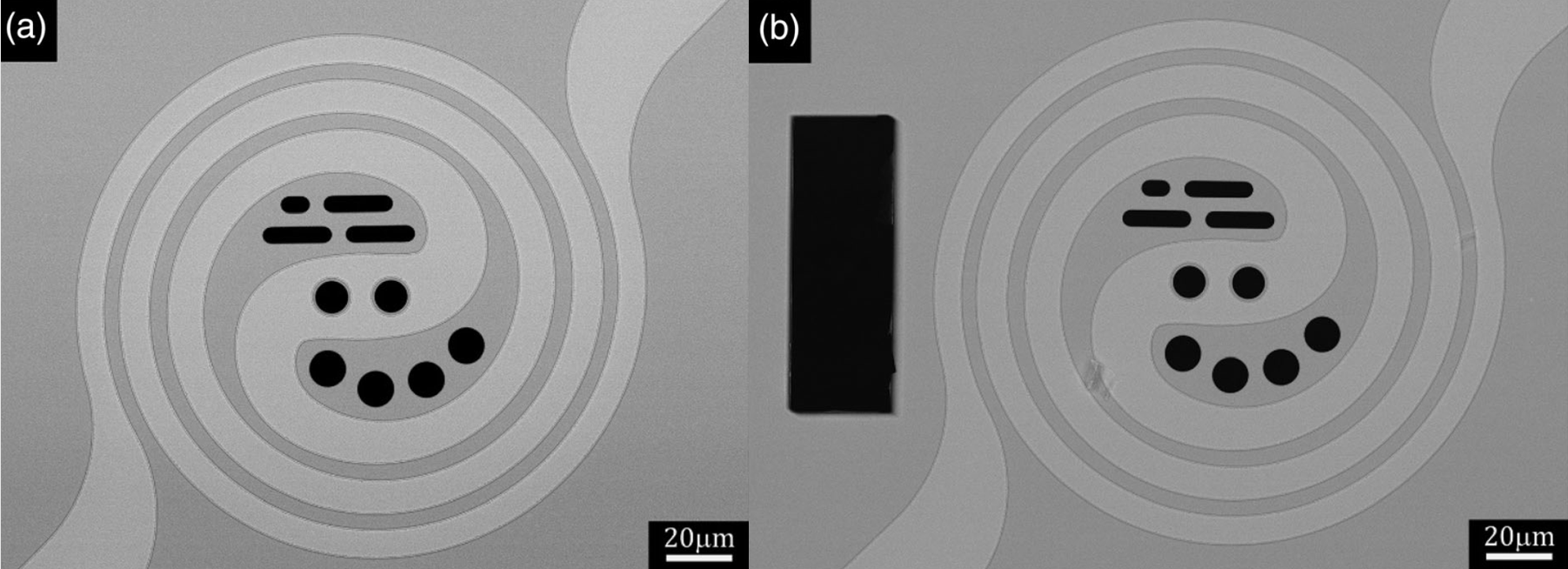
Using a Helios Nanolab 600 DualBeam focused ion beam (FIB)/scanning electron microscope (SEM), the researchers were able to modify a standard Nano-Chip. The Ga+ ion-based FIB was operated at an accelerating voltage of 30 kV and 6.4 nA beam current to mill a rectangular window next to the spiral metallic heater. This milled window can be seen in Figure 1b below. Importantly, after the FIB modification, the modified Nano-Chip exhibited no signs of deterioration in performance. 

Figure 2: Marc Willinger

Figure 1: SEM images of the (a) unmodified Nano-Chip and (b) modified Nano-Chip.

Lamella preparation and transfer

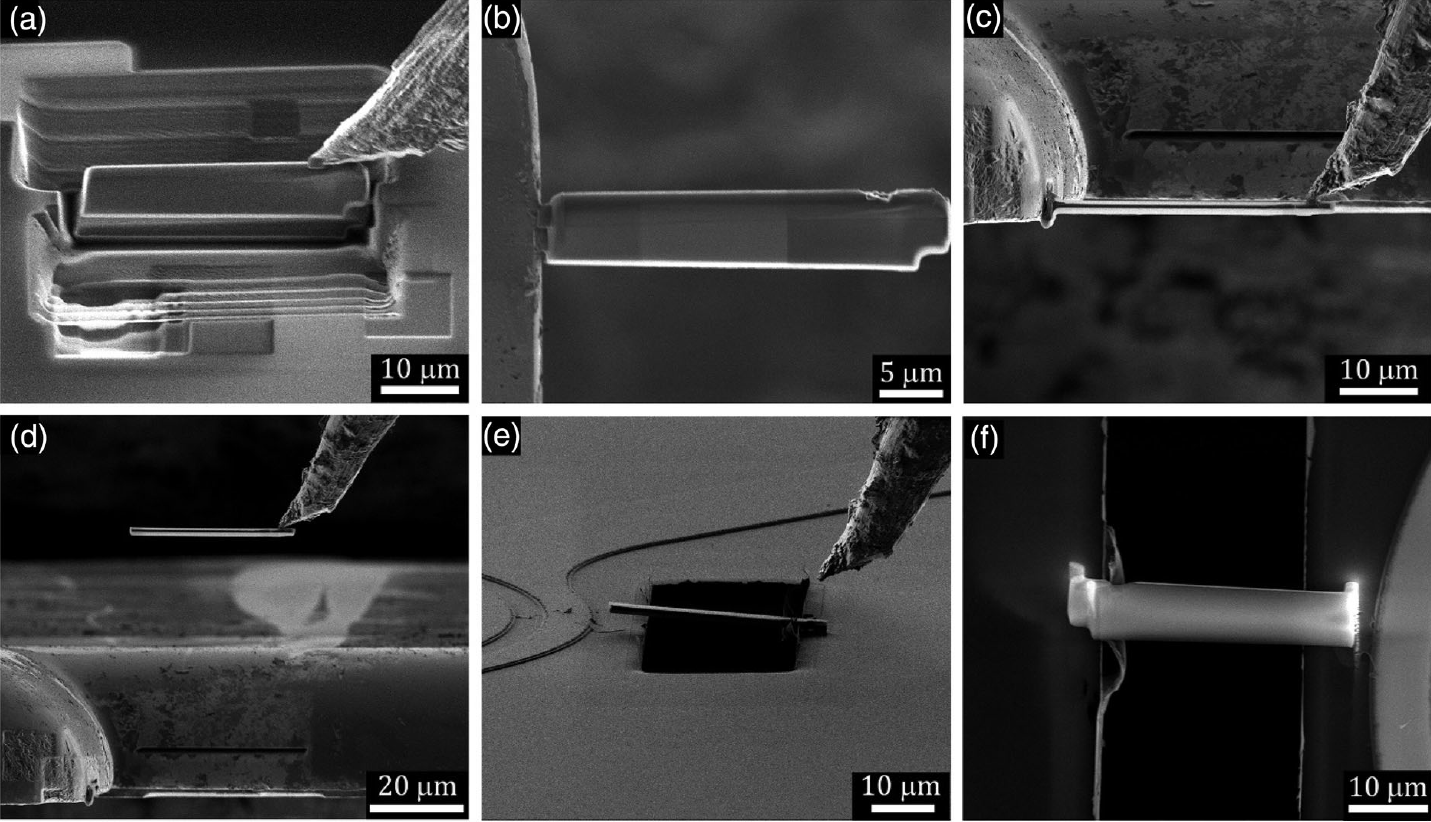
Next, the researchers worked on preparing and transferring the FIB lamella from a (001) oriented single crystal silicon wafer surface onto the Nano-Chip. This workflow is detailed in Figure 2a–f below. The FIB-cut Si lamella was placed across the larger window (Figure 2e), with one end of the lamella on the heater and the other end on the SiN membrane acting as the heat sink. The Si lamella was welded to the MEMS heater using a Pt-based Gas Injection System (GIS) needle with the aid of the Ga ion beam. The Pt was welded at the top left edge and top right edge of the lamella as seen from the SE Image in Figure 2f.

Figure 2: Marc Willinger

Figure 2: Secondary electron (SE) and ion (SI) images of the FIB preparation and transfer of the lamella over the modified window in the FIB.

Ex situ temperature calibration

At Dr. Kong’s lab (Virginia Tech), the researchers then performed infrared thermal imaging (IRTI) experiments on the MEMS devices under ambient air conditions. IRTI is a particularly useful ex situ approach to measure the spatial distribution of temperature across the MEMS-device with a reasonable degree of accuracy. Using IRTI, the temperature distribution was measured across both the unmodified and modified Nano-Chip. 

1) Temperature distribution across the unmodified Nano-Chip

First, the researchers measured the temperature distribution across the unmodified Nano-Chip to obtain reference temperature measurements. This distribution indicated that the metallic spiral heating element surrounding the viewing area of the microheater exhibited the highest temperature. Moreover, based on the temperature profile of the MEMS microheater, the spiral metallic heating element is the “hottest” region, while the surrounding SiN membrane is the “coldest” region on the MEMS device. These thermal conditions result in a large thermal gradient between the spiral metallic heater (= the “heat source”) and the SiN membrane (= the “heat sink”). 

2) Temperature distribution across the modified Nano-Chip

In order to generate a thermal gradient across a specimen, a FIB-cut lamella must be placed such that one end of the specimen is on or adjacent to the heater and the other end is on the SiN membrane, away from the heater. 

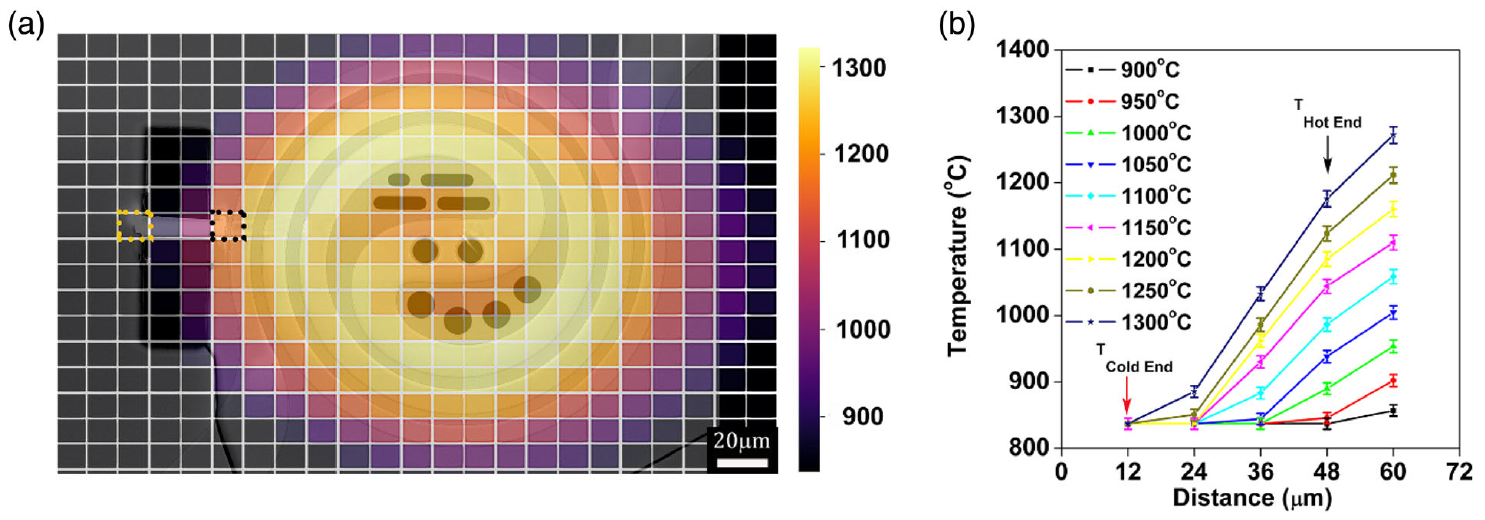
The researchers then performed IRTI again, but on the modified Nano-Chip with a FIB-cut lamella of Si placed across the modified window. As shown in Figure 3a below, the “hot end” of the Si lamella was adjacent to the outer spiral of the metallic heater, represented by the region enclosed in the black dotted square. On the other hand, the “cold end” was across the window in the SiN membrane, represented by the region enclosed in the yellow dotted square. Next, the thermal gradients across the FIB-cut TEM specimen were measured via an established technique that allows temperature measurement inside the TEM with high spatial resolution. 

Figure 2: Marc Willinger

Figure 3: Overlay of the SEM image of the modified device with Si lamella on the thermal map of the device at 1300°C (unit of heatmap scale is in C), (b) the horizontal temperature line profile along the “hot end” (enclosed in dotted black square) and “cold end” (enclosed in dotted yellow square) of the Si lamella.

In situ temperature calibration

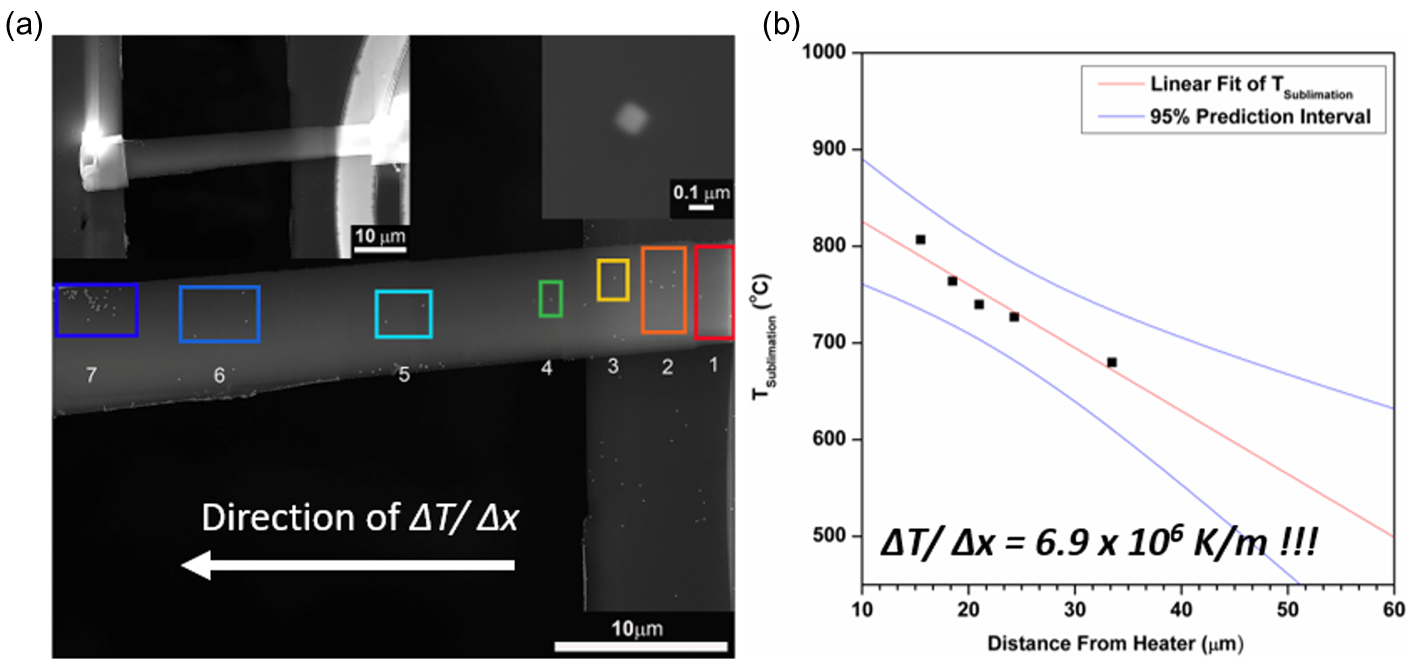
In order to validate the ex situ results and accurately measure the temperature across the FIB-cut specimen, the researchers measured the temperature via the established Ag nanocube (NC) sublimation method. The lamella was again placed such that the “hot end” was over the central spiral metallic heater and the “cold end” across the modified window. Next, monodispersed Ag NCs were dispersed onto the FIB lamella. The modified Nano-Chip was then heated to a set point temperature of 1,000°C and held until the Ag NCs completely sublimate. In Figure 4a below, the Ag NCs that dispersed across the FIB lamella are highlighted with colored boxes and labeled as regions 1–7. After sufficient sublimation events on the lamella were observed, the sublimation experiment was halted. Notably, the Ag NCs in region 6 and 7 did not completely sublimate, as the sublimation kinetics slowed down at lower temperatures. 

“When exposing the FIB-cut TEM lamella to a combination of extreme thermal gradient heating and thermal cycling, the DENSsolutions Nano-Chip was observed to be extremely stable. The impulse software was very useful for these experiments as it allowed us to design complex temperature profiles during the heating experiments.” – Dr. Sriram Vijayan, Post-Doctoral Researcher, Center for Electron Microscopy & Analysis (CEMAS), The Ohio State University

The researchers then estimated the mean temperature of the Ag NCs on the FIB lamella found within regions 1–5. Subsequently, the mean temperatures obtained from regions 1 to 5 were plotted against the relative distance from the heater. In figure 4b below, a linear fit of the temperature data with 95% prediction intervals is presented. The thermal gradient of ΔT/Δx = 6.3 x 10⁶ °C/m was calculated at the temperature set point of 1,000°C. 

The in situ results confirm that the researchers’ proposed modification of our Wildfire Nano-Chip has indeed generated a large thermal gradient across the FIB-cut TEM specimen. In fact, this resulting thermal gradient was found to be in the range of gradients observed in several engineering and manufacturing applications. Ultimately, this innovative approach now opens up the scope of research to address a wide range of material science problems observed under transient thermal conditions.

Figure 2: Marc Willinger

Figure 4: (a) SEM image of different regions (1–7) across the Si lamella where the temperature of the lamella was measured. (b) The linear fit of the temperature from the “hot end” to the “cold end” superimposed over the plot of the measured sublimation temp from region 1 to 5 versus distance from the “hot end”.
.

Conclusion

This paper presents a very simple methodology to study non-equilibrium processes in materials under extreme thermal gradients and rapid thermal cycling conditions. Specifically, this modified Nano-Chip can enable dynamic studies of the microstructural evolution in materials used in several critical applications, including nuclear reactor components, microelectronic packages and additively manufactured builds. 

In the case of metal-based additive manufacturing (AM), extreme spatial and temporal thermal transients significantly impact the material microstructure within the melt pool and regions below the melt pool (‘previously melted’ layers of an AM build). Using this novel in situ TEM heating approach, we can now begin to observe and understand physical processes that contribute to the microstructural evolution in ‘previously melted’ layers during AM, thereby closing gaps in our understanding of processing-structure-property relationships in metal-based AM.

Ultimately, this powerful device can accurately simulate these complex thermal conditions inside the TEM and capture the microstructural evolution of materials during such extreme processing conditions. We are truly proud of the role that our Wildfire system has played in making this research possible and strive to continue enabling groundbreaking research now and in the future.

Hanglong Wu portrait

“Our modified DENSsolutions Wildfire Nano-Chip is well-suited for in-situ TEM heating experiments that require ‘far-from-equilibrium’ thermal conditions. This enables the observation of dynamic processes in a wide range of material systems at the nanoscale, which will further our fundamental understanding on microstructural stability of materials during processing and under ‘in-service’ conditions.” 

Dr. Joerg Jinschek
Professor |  Technical University of Denmark

Original article:

Discover our Wildfire solution:

Discover more publications made possible by Wildfire:

Thomas article feature image

New measuring technique proves exceptional temperature accuracy of our Wildfire Nanochip

In collaboration with Utrecht University, we develop a novel technique to measure temperature at the nanoscale, showing the remarkable temperature accuracy and homogeneity of our Wildfire Nanochip.

Subscribe to our newsletter to stay up-to-date with the latest in situ microscopy news.