Meet Dr. Evgeniya Pechnikova, our new Senior Applications Development Scientist

Meet Dr. Evgeniya Pechnikova, our new Senior Applications Development Scientist

We are happy to announce that DENSsolutions has expanded the team with a wonderful new colleague – Dr. Evgeniya Pechnikova.

In the pursuit to grow our applications development for the DENSsolutions Stream system and other future product lines, we recently welcomed Dr. Evgeniya Pechnikova to the team – our new Senior Applications Development Scientist. Evgeniya has years of experience and high-level technical expertise in electron microscopy (EM), including cryogenic-EM, tomography and data processing techniques. Her role at DENSsolutions will be focused on developing novel in situ liquid EM applications that demonstrate the power of our solutions. She will also be working on creating new techniques and methodologies that will support the research of our customers, as well as perfecting our demonstration and installation protocols. We are thrilled to have Evgeniya join the DENSsolutions family and look forward to the valuable contributions she will make to the team on both a personal and professional level. In this article, we have asked Evgeniya to introduce herself so you can learn more about her extensive experience and her new role at DENSsolutions.

Meet Dr. Evgeniya Pechnikova

“My name is Evgeniya Pechnikova, and I was born and raised in Moscow, Russia. I have a lot of love for adventure and history, and enjoy travelling around the world to explore ruins of ancient civilizations. I’m also an avid fan of photography, Latin social dances like salsa and tango, as well as playing badminton and a game known as ‘werewolves’!

I have always been drawn to different spheres of science. That is why for my higher education, I decided to enrol in Lomonosov Moscow State University‘s biological faculty. As they had a very broad program there, I had the opportunity to learn about a wide range of subjects, starting with mathematics and physics and ending up with biochemistry, plant physiology and even drawing.

During my master’s degree, I was introduced to the world of electron microscopy and was completely fascinated by its combination of science and photography – two topics that have always been a passion of mine. To add another dimension to my work, I found a PhD position in the field of cryo-EM and 3D reconstruction, working on investigating the structure and function of capsids of a helical plant virus. My PhD project was a result of a collaboration between Lomonosov Moscow State University, Institute of Crystallography in Moscow and Birkbeck, University of London. During this PhD, I worked in close collaboration with structural biologists that were highly experienced in cryo-EM and image processing before the new detector technology popularised the technique to a broader base of scientists. This was an incredibly enriching experience and certainly shaped my career path moving forward.

After completing my PhD, I joined Thermo Fisher Scientific in the Netherlands where I worked as an Applications Scientist in the Eindhoven NanoPort facility – a state-of-the-art electron microscopy facility that provides users with hands-on experience with numerous analytical techniques. During this role, I was responsible for providing training and demonstrations for life science TEM equipment. I was also in frequent collaboration with the R&D department to translate customer needs into applications development, and to test new hardware and software tools. As a result of this work, I was able to play a role in accelerating the new-resolution revolution that has bloomed in cryo-EM over the past couple years. Importantly, this role made me realize that trying new tools to solve long-standing problems is what excites me most. 

Now, as a Senior Applications Development Scientist at DENSsolutions, I have the unique opportunity to combine and explore two cutting-edge technologies, MEMS and cryo-EM. My top priority is to boost applications development and create working protocols that showcase the advantages of DENSsolutions’ MEMS technology within in situ liquid EM. I look forward to being actively involved in hands-on support during on-site and remote product demonstrations, as well as working with other departments to translate customer needs into workable solutions. I am excited to take on this new challenge and am confident that I will be able to make a meaningful contribution to the company, our customers and science as a whole.”

Get in touch with Evgeniya via:

Subscribe to our newsletter to stay up-to-date with the latest in situ microscopy news.

Meet our new Vice President of Sales and Business Development, Hans Radhoe

Meet our new Vice President of Sales and Business Development, Hans Radhoe

We are excited to announce the expansion of our team with our new colleague, Hans Radhoe.

Despite being a small company in the canal-ringed city of Delft, DENSsolutions has always been highly ambitious, with its sights set on disruptive growth and innovation. Keeping in line with this, we wanted to expand our team with someone who could lead our business development, with a focus on the discovery of new growth opportunities for the company and making our many visions a reality. We are happy to have found just the right person for this position – Hans Radhoe, our new Vice President of Sales and Business Development. With over 25 years of experience in business and development within fields such as life science and materials science, Hans has an extensive understanding of lead generation, advancing business strategy and the sales cycle process within diverse scientific markets. His role at DENSsolutions will focus on finding avenues of growth for the company and leading numerous aspects of the sales process, from prospecting and go-to-market strategies to customer relationship management. In this article, we have asked Hans to introduce himself so you can learn more about his education, experience and role at DENSsolutions. 

Meet Hans Radhoe

“My name is Hans Radhoe, and I was born in Suriname, a country in South America in the Amazon. At just 17 years old, I left Suriname with the bright intention to study medicine in the Netherlands. I had no knowledge at that time, however, that there was a lottery system in place in the Netherlands for being admitted into any of the medical schools in the country. As it turned out, I was not one of those selected to move forward in the admission process, which forced me to think of an alternative study to pursue.

This chain of events catapulted the start of my education in the field of biotechnology, which I studied at the Polytechnical Faculty in Delft. Studying biotechnology felt like an excellent choice for me since it not only piqued my interest, but was also a hot topic in the 80s and beyond. After finishing my Bachelor studies, my fascination with the environment led me to pursue a Master’s degree in Environmental Management at Open University in Heerlen, a small city in the southeast of the Netherlands bordering Germany.

After graduating, I took on a position for a couple years with the task of setting up a mycoplasma and virology lab in accordance with CGMP guidelines. In this role, I managed to upscale Mycoplasma testing services for the pharmaceutical industry. I then worked at Centocor in Leiden for a short while, which is a biotech subsidiary of Johnson & Johnson. During this role, I was responsible for the production of biologic drugs involving monoclonal antibody technology, such as Remicade – a drug used to treat a number of autoimmune diseases like rheumatoid arthritis. It was particularly during this role that I gained hands-on experience in cell and gene therapy. 

Shortly after, I made the switch from lab to business because I became more and more passionate about perceiving and fulfilling the commercial needs of others. During my business jobs, I realized how imperative it is to be able to listen intently and actively when in communication with customers. This encouraged me to take a Master’s in Counselling and Coaching, which is part of the Psychology study at the Radboud University Nijmegen. Although the intention of pursuing this Master’s was to use the knowledge learnt to enhance my communication with clients, I found myself applying it in the volunteer work that I did next to my job at the time. This volunteer work involved coaching cancer patients at the Nederlandse Federatie van Kankerpatiëntenorganisaties, which I happened to stumble upon when seeing an advertisement from the organisation on TV. 

Further down the line in my career, after many enriching vocational experiences, I started working as the Sales Director at Amsterdam Scientific Instruments (ASI) – a spin-off company from Nikhef, which is a Dutch research institute for particle physics. ASI specializes in the design and manufacturing of advanced detector solutions for all kinds of particles, such as electrons. Indeed, it was particularly during this position that I stepped into the world of electron microscopy, which I found to be rather fascinating.

This then brings me to today, where I now have the role of Vice President of Sales and Business Development at DENSsolutions, a company that develops advanced electron microscopy solutions. I have actually been following DENSsolutions for a long time since a friend of mine worked here, and I have witnessed for myself the rapid innovation of the company in the past few years. Generally, in the span of my career, I have been active in numerous scientific markets all over the world and in many different positions, including account management, sales and business development. In my new role, I will be in charge of increasing the company’s presence in existing markets, as well as forming strategic partnerships that open up entirely new ones. I look forward to applying my extensive knowledge gained over the past two decades into this new role, and being part of a fantastic team so focused on continuous cooperation and innovation.”

Get in touch with Hans via:

Subscribe to our newsletter to stay up-to-date with the latest in situ microscopy news.

Liquid flow control: Unlock untapped research capabilities within in situ LPEM

Liquid flow control: Unlock untapped research capabilities within in situ LPEM

Via the unique on-chip microfluidic channel of the DENSsolutions Stream system, researchers were able to create a highly controlled chemical environment for visualizing the nanoscale metallic electrodeposition of copper crystals.

Original article by Cheng et al.

Liquid phase transmission electron microscopy (LPTEM) enables the observation of time-resolved dynamics in liquid state at high spatial resolution. The technique has gained exponential popularity over the last decade, and has contributed greatly to a wide range of fields, including materials science, chemistry and life science. With LPEM, researchers can explore the dynamical evolution of key materials and uncover fundamental insights into nucleation and growth. Only in recent years have researchers been able to control the chemical environment within an in situ LPEM experiment, owing to the award-winning innovation that is the DENSsolutions Stream system. In a recent publication, researchers including Dr. Ningyan Cheng from Anhui University utilized the Stream system to visualize the metallic electrodeposition of copper crystals in a highly controlled chemical environment. This was made possible due to the unique on-chip flow channel of Stream, which enables numerous advantages such as the ability to flush away beam-induced species, explore flow-dependent liquid dynamics and easily change electrolyte composition.

On-chip microfluidic channel

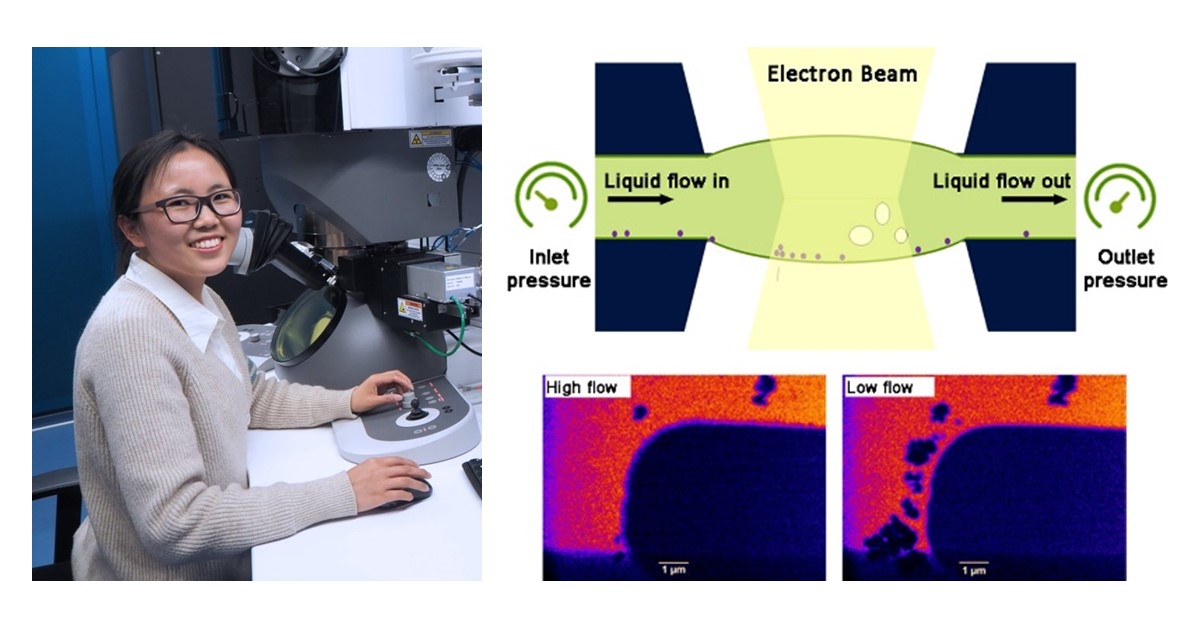
The core of the DENSsolutions Stream system is our patented Nano-Cell, which consists of a top and bottom chip, together forming a sealed compartment that enables users to safely perform liquid experiments inside the TEM. The bottom chip contains spacers, an integrated liquid inlet, flow channel and an outlet. Via pressure-based pumps, a liquid sample can be driven from the inlet through the field of view and then through the outlet. This process is demonstrated in the video below. Importantly, users can independently control the pressure at the inlet and outlet of the Nano-Cell, and therefore the absolute pressure in the microfluidic channel. This then enables full control over the liquid flow rate within the cell.

Movie 1: Animation depicting the microfluidic channel of the Stream Nano-Cell

Efficient liquid flow

Before observing any liquid phenomena in the TEM, Dr. Cheng and her fellow collaborators first had to ensure that the flow was efficient and well-controlled. To do this, the researchers first assembled a dry Nano-Cell. The flow was then initiated by turning on the pressure-based pump, while keeping all imaging parameters constant. After 30 seconds, the imaging contrast changed abruptly, implying that the liquid had definitely flowed into the Nano-Cell. This process is shown in the video below. The time taken to completely fill the Nano-Cell ranges anywhere from tens of seconds to just 3 minutes when a flow rate of 8 μl/min is applied.

Movie 2: In situ TEM movie showing the liquid flow into the Nano-Cell in just 30 seconds

Removal of beam-induced species

A key benefit of controlling the liquid flow within an LPEM experiment is the ability to remove beam-induced particles. The researchers first generated particles by increasing the electron flux on purpose through changing the spot size from 5 to 1. The process of removing the beam-induced species in this experiment is detailed in the video below, with the direction of the flow going from top to bottom. As soon as the flow was cut off at 6.4s, the particles started to form and grow on the membrane. The flow was then switched on again at 11.7 seconds, which is when the particles that were stuck to the membrane started to peel off and move from the top to the bottom area in the field of view. It took just 2 minutes to fully flush away the particles, which is a reproducible process. The direction of the particles’ movement is the same as the direction of the flow (top to bottom), confirming the effectiveness and power of the liquid flow control. 

Movie 3: Removal of beam-induced species via liquid flow control

Capturing flow-dependent liquid dynamics

The next step for the researchers was to explore the effect of the flow rate on the electrochemical copper crystallization and dissolution processes in real time. They first observed the effect of using a higher flow rate of 1.4 μl/min on the Cu deposition and dissolution processes, which showed to be reversible. The protocol included the initial electrode cleaning, deposition (−0.9 V, 10 s), dissolution (+0.4 V, 15 s) and repeating the process for 4 cycles. As demonstrated in the video below, the researchers found that uniform copper deposition can be obtained at a higher liquid flow rate (~1.4 μl/min), whereas at a lower liquid flow rate (0.1 μl/min), the growth of copper dendrites was observed. 

Movie 4: Copper electrodeposition at a flow rate of 1.4 μl/min (left) and 0.1 μl/min (right)

Changing electrolyte composition

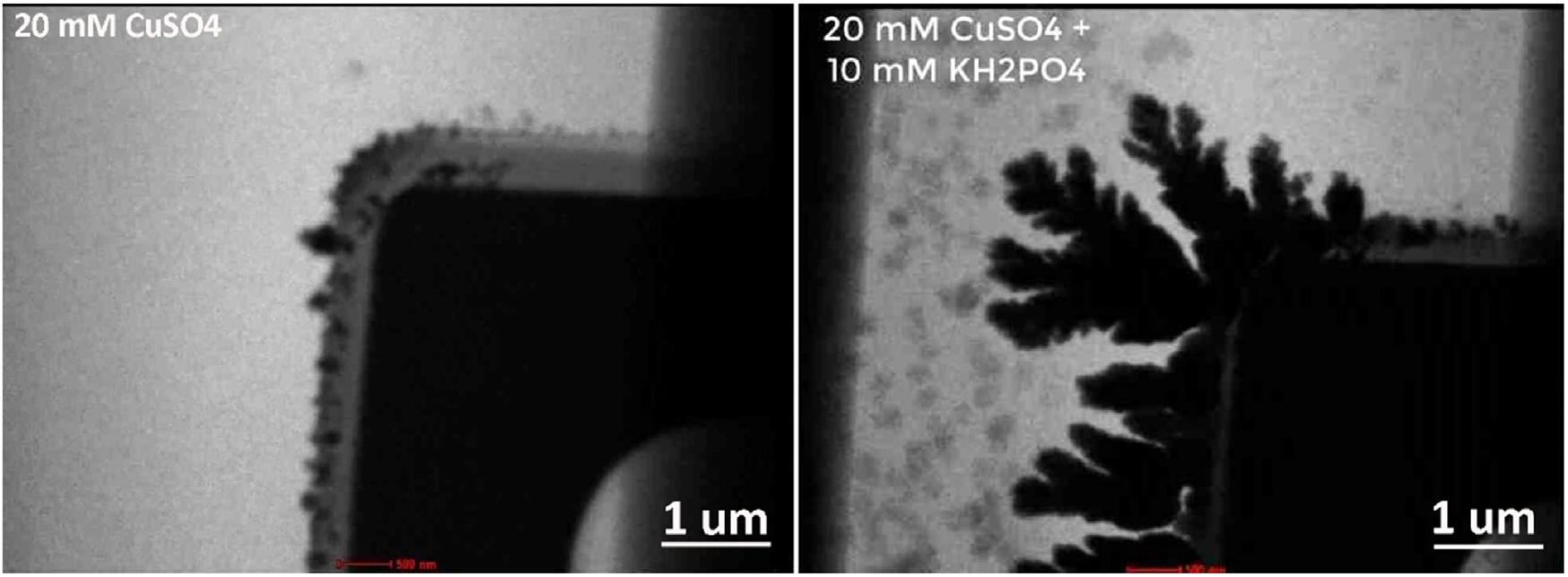
Besides exploring the effects of altering the flow rate, a major point of interest in this study was observing the effect of adding foreign ions, such as phosphates, on the electrodeposition. Such additives can affect the electrochemically deposited crystals by, for example, changing the nuclei structures. The researchers first studied the electrodeposition of copper from a pure CuSO₄ aqueous solution. In this case, no obvious dendritic morphology was observed and instead only granules were formed (see below Figure 1, Left).

After the experiment, the electrolyte in the sample source was replaced by a mixture of CuSO and KHPO solution. The liquid was kept flowing with a flow rate of 3 μl/min for 15 min, which enabled the researchers to directly study the electrolyte effect on the depositions in the same liquid cell by excluding all the uncertainties during different cell assembly. Contrastingly in this case, copper dendrites were observed to grow and the addition of HPO− ions in the electrolyte led to the formation of Cu-phosphate complexes (see Figure 1, Right). These results further confirm the importance of being able to modulate the electrolyte composition, and demonstrate the effectiveness of the environment control that Stream enables.

Figure 1: The effect of phosphate addition on Cu electrodeposition

Exploiting electrode design to alter the chemical environment

When studying Cu electrodeposition in the previous experiment, the researchers saw that dendrite formation can be further promoted by the in situ addition of foreign ions, such as phosphates. In order to confirm the generality of this technique, they also took a look at Zn electrodeposition in an aqueous solution of ZnSO. The figure below shows the total growth of the zinc layer at b) a lower potential of −0.9 V (versus Pt) in the first 10 seconds, and c) a higher potential of −1.1 V (versus Pt) in the next 10 seconds. In d) the total growth of the Zn depositions in the first 20 seconds is shown. The researchers observed in the first 10 seconds (−0.9 V) that the deposition on the inner edge is rougher compared to the outer edge. In the following growth at −1.1 V, dendritic depositions are nucleated and grown on the previous outer edge, while no further growth can be observed in the inner edge. This experiment demonstrates that the special electrode design of Stream enables the exploration of rich liquid dynamics within different chemical environments. 

Figure 2: Zinc electrodeposition in b) the first 10 seconds with a potential of −0.9 V and c) in the next 10 seconds with a potential of −1.1 V. d) shows the total Zn growth in the 20 seconds.

Conclusion

Through this study, it is shown that Stream’s distinctive ability to enable liquid flow control opens the doors for researchers to truly alter the chemical environment within the liquid cell. By controlling the liquid flow, a user can flush away beam-induced species, explore flow-dependent liquid dynamics and easily change electrolyte composition. Moreover, the unique design of the electrodes in the Stream system allows researchers to explore complex liquid dynamics within different chemical environments within the same liquid cell. Importantly, the direct observations made by Cheng et al. not only provide new insights into understanding the nucleation and growth, but also give guidelines for the design and synthesis of desired nanostructures for specific applications, such as high performance electrocatalysis for energy conversion and electrodes for secondary batteries. 

Hanglong Wu portrait

Image of Dr. Ningyan Cheng from Max-Planck-Institut für Eisenforschung GmbH

“The DENSsolutions Stream System not only provides a useful means to study a wide range of dynamics in solution, but also enables systematic studies of the effect of the chemical environment on the corresponding reactions through precise control of the flow rate, liquid composition and other significant parameters.” 

Prof. Dr. Ningyan Cheng   Associate Professor  |  Anhui University

Original article:

Discover our Stream solution:

Discover more publications made possible by Stream:

Thomas article feature image

Climate helps uncover phase coexistence and structural dynamics of redox metal catalysts

Using our Climate system, scientists are able to interrelate the atomic-scale structural dynamics of redox metal catalysts to their activity.

Subscribe to our newsletter to stay up-to-date with the latest in situ microscopy news.

DENSsolutions has installed yet another Climate system in the U.S. at Alfred University

DENSsolutions has installed yet another Climate system in the U.S. at Alfred University

We are proud to announce that DENSsolutions has installed another Climate system in the United States, at Alfred University, which is located in the west of New York State. In this article, we interview Dr. Kun Wang, Assistant Professor at the Inamori School of Engineering in Alfred University, to learn more about their microscopy facility, its research direction, as well as how our Climate system is advancing their research.

Can you tell me more about the microscopy facility at Alfred University?

Alfred University has numerous research facilities that boast a wide range of high-tech equipment. There are dedicated facilities for materials characterization, mechanical and physical testing, biological evaluation of materials, spectroscopy, materials synthesis and processing as well as imaging and microscopy. The Imaging and Microscopy facility is equipped with a scanning electron microscope, an atomic force microscope and a fluorescent optical microscope, among many other tools. Just last summer, we had our new transmission electron microscope installed, the TFS Talos F200X. This microscope is equipped with a super X-ray detector which enables us to perform high resolution chemical analyses in a highly efficient manner.”

What type of applications are the users at Alfred using the Climate system for?

“Users of the facility are interested in a couple of applications, now enabled via the use of our newly acquired DENSsolutions Climate system. Via Climate, we would like to perform in situ oxidation and reduction experiments on batteries and catalyst materials. Moreover, we are interested in performing in situ high-temperature oxidation experiments for aerospace materials and nuclear matter in order to better understand these materials and their behavior under varying temperature conditions. We are also interested in performing energy-dispersive X-ray spectroscopy (EDX) in those experiments to get a better idea of the elemental composition of a given sample.”

What particular features of the DENSsolutions Climate solution attracted you to the system?

“Aside from the ability of the system to combine gas and heating functions, it was particularly important for me to use an in situ system that could handle high temperatures. Specifically, I was looking for a system that could handle high temperatures while still maintaining the stability of the holder. This is particularly what attracted me most to the Climate system.”

Can you tell me about the grant that was won to acquire the system?

“The grant was actually awarded several years ago, from an institute called the New York State’s Empire State Development, which provides numerous services and resources for education, healthcare, military and other fields.”

DENSsolutions Prof. Jungwon Park

Dr. Kun Wang
Assistant Proffessor | Inamori School of Engineering, Alfred University

Dr. Kun Wang received his Ph.D. degree in Materials Science and Engineering from the Swiss Federal Institute of Technology Lausanne (EPFL). He used to work as a Postdoctoral Research Associate at the Nuclear Materials Science and Technology group of the Oak Ridge National Laboratory (ORNL). Currently, he is working as an Assistant Professor at the Inamori School of Engineering, Alfred University. His research focuses on study of structural materials under extreme environmental conditions.

Discover Dr. Kun Wang’s publications:


Learn more about Climate:


Discover publications made possible by Climate:

Subscribe to our newsletter to stay up-to-date with the latest in situ microscopy news.

A comprehensive guide for data synchronization in operando gas and heating TEM

A comprehensive guide for data synchronization in operando gas and heating TEM

A team of experts develop a data synchronization method for operando gas and heating TEM via time delay calibration, enabled by the unique ability of the DENSsolutions Climate Nano-Reactor to perform nano-calorimetry.

Original article by Fan Zhang, Merijn Pen, Ronald G. Spruit, Hugo Perez Garza, Wei Liu, Dan Zhou

In recent years, operando gas and heating transmission electron microscopy (TEM) has become recognized as a powerful tool for creating time-resolved correlations between the environment, reaction products, energy transfer and material structures during reaction processes. Via operando gas and heating TEM, a detailed understanding of the relationship between the structural evolution of a catalyst and its performance can be achieved. Despite its many benefits, one inevitable issue with the technique is the intrinsic time delays that occur between different parameter measurement locations. These time delays must be calibrated in order for researchers to draw valid correlations and conclusions. Correlations without time delay calibration could lead to, for example, over/under-estimating critical temperatures and generating misleading relationships between catalytic structure and activity.

In recent research performed at the Dalian Institute of Chemical Physics (DICP), Chinese Academy of Sciences, where our advanced Climate G+ system is installed, Fan Zhang, Dr. Wei Liu and our own team of experts, including Merijn Pen, Ronald G. Spruit, Dr. Hugo Perez Garza and Dr. Dan Zhou, developed a data synchronization method to account for time delays in operando gas and heating TEM. Specifically, they systematically explored the relationship between delayed time and reaction conditions such as gas pressure, flow rate and gas composition. Based on the results, they developed open source scripts that can be used to achieve reliable and automated data synchronization via time delay characterization and calibration. The authors also developed a general protocol to perform automatic time delay calibration for all kinds of TEM setups.

The experimental setup

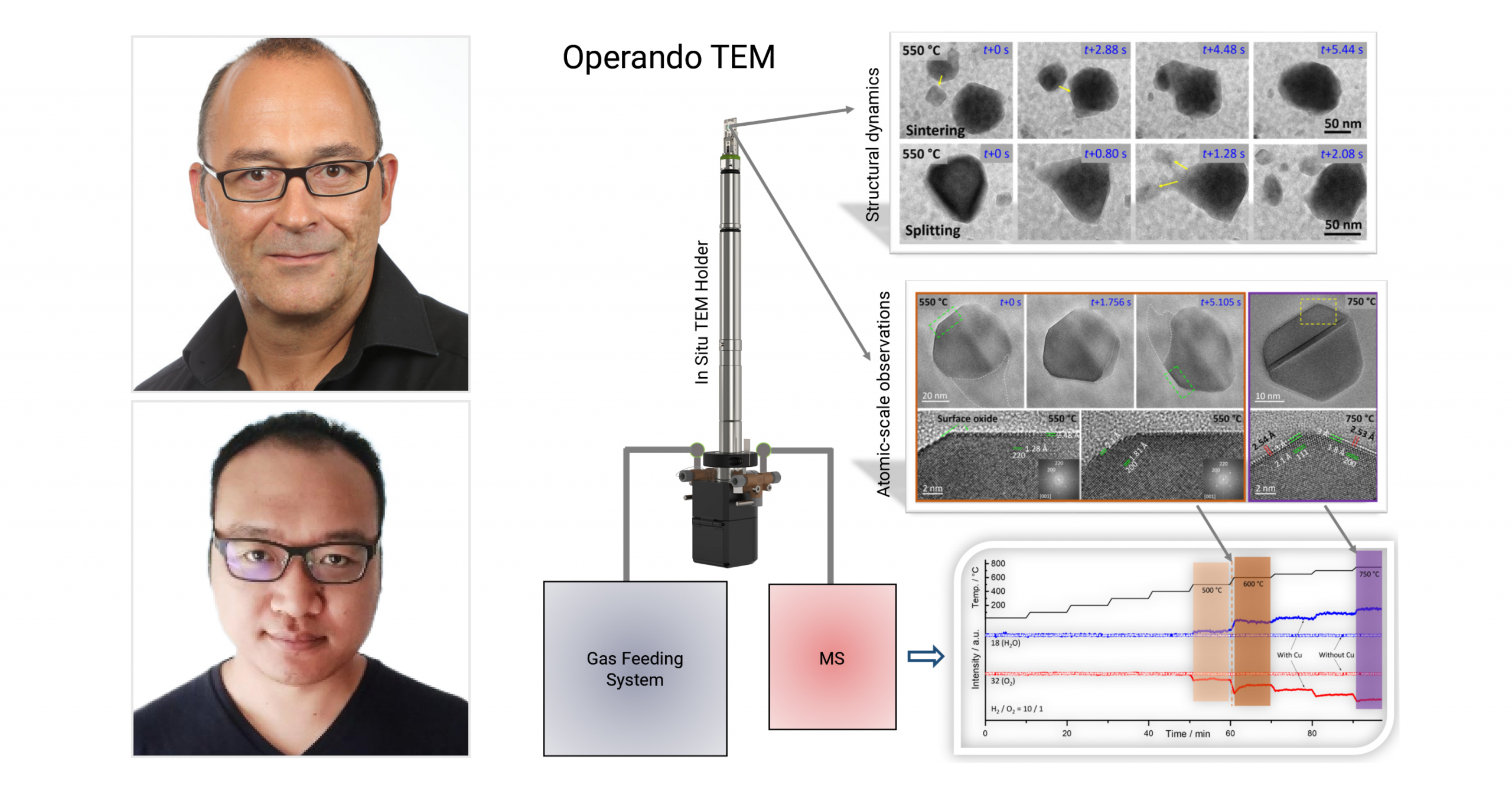
The experimental setup used in the study included the DENSsolutions Climate Gas Supply System (GSS), Climate in situ TEM holder, Climate Nano-Reactor, Gas Analyzer and Thermo Fisher Scientific Themis ETEM. In Figure 1a) below, a schematic view of the operando gas and heating TEM setup is presented. Generally, a gas will first travel from the GSS into the TEM, and then from the TEM into the Mass Spectrometer (MS), also known as the Gas Analyzer. This process is depicted in Movie 1 below. The different colors in the video visualize what happens when the gas composition is changed, where a new color represents a new gas mixture. In this visual depiction, it is shown that the gas composition measurement at the GSS is actually ahead in time of the measurements at the TEM. This is because the gas takes time to reach the sample. Moreover, the measurements from the MS are also delayed because the gas needs time to flow from the TEM to the MS. A more detailed account of the gas path and the components involved is provided below.

The GSS contains three gas bottles as well as three flow controllers that measure and regulate the gasses’ flow rates. The gasses are mixed using a unique on-the-fly mixing technique, where a user can change the gas composition dynamically as well as alter the gas environment within a matter of seconds. The mixed gas is then guided into the Nano-Reactor in the TEM through the holder, and then to the MS, which derives the outlet gas composition by measuring the partial pressures of reactants and products. Expectedly, as the gas travels through this path, considerable time delays occur. In fact, the researchers found that a user-set gas composition change in the GSS will only show changes in the MS after 79.1 seconds (see Figure 1b) below). 

Movie 1: Movie depicting the gas path and time delays associated with operando gas and heating TEM.

Figure 1: (a) A schematic view of a gas cell based operando TEM gas path; (b) Illustration of time delay between GSS and MS. Here GSS data are measured by flow meter and MS by measuring the ionized gasses’ mass to charge ratio.

In Figure 2 below, a diagram of the operando gas and heating TEM setup used in this work is presented. The setup can be grouped in two ways: from a hardware perspective and from a gas path/TEM investigation perspective. In the case of the former grouping, the setup can be divided into GSS, TEM and MS. In the case of the latter grouping, the setup can be divided into pre-TEM, in-TEM and post-TEM. The researchers were able to synchronize the data from pre-, in- and post-TEM by first measuring and then calibrating the time delays involved. 

Figure 2: A diagram of the operando gas and heating TEM setup.

Calorimetry-based time delay calibration

The DENSsolutions Climate system offers users the unique ability to perform nano-calorimetry, which comes in as a convenient feature in the calibration of time delays. Specifically, when a new gas type enters the Nano-Reactor, this is detected by the microheater because it is very sensitive to even the most minute changes in heat. Users can monitor the gas changing process due to the difference in the thermal properties of the different gasses flown through the Nano-Reactor, enabling the detection of what time the new gas has reached the sample. The unique on-chip calorimetry feature of our Nano-Reactor allows for calibration of the time delays, and therefore enables perfect synchronization between gas compositional changes, TEM imaging and spectroscopy data.

Relationship between time delay and various parameters

The next step for the researchers was to systematically explore the relationship between the delayed time and reaction conditions such as gas pressure, flow rate and gas composition. They found that the delayed time between different parts, in either of the two grouping mechanisms, is determined by the gas pressure and flow rate in the Nano-Reactor, as well as the total gas path length. They also found that the time delay has little dependence on the gas type. The investigation of the relationship between the time delay and the above-mentioned critical parameters allowed the researchers to develop a functional relationship. Using the established functional relationship, they were able to lay the foundation for manually and automatically calibrating the time delays.

Automation of data synchronization

Based on the investigations, the authors developed algorithms and scripts to enable the automatic data synchronization in operando gas and heating TEM. Specifically, two open source Python scripts have been written for characterizing and calibrating the time delays in experiments. 

The first script characterizes the time delay curve, utilizing DENSsolutions Impulse API and ImpulsePy library to control and retrieve the measurements from the GSS, the heating control unit and the MS. It does this by alternating between different gas mixtures and measuring the time delays until these gas composition changes are detected in the calorimetry data of the microheater and in the partial pressure data from the Mass Spectrometer. It performs multiple gas composition switches at different flow-rates and pressures to collect enough data points to be able to fit the two characterization curves through them. These curves are the pre-TEM to in-TEM delay and the in-TEM to post-TEM delay characterization curves of that specific system. The characterization only needs to be performed once, after which the calibration file can be used repeatedly on any dataset measured by the same system.

The second script removes the time delays from a dataset by first splitting the system parameters into different sets: pre-TEM, in-TEM and post-TEM. Because the pressure and flow parameters can change over the duration of the experiment, the time delay correction amount is calculated and applied for every measurement in the dataset individually. The script then saves three corrected datasets (pre-TEM, in-TEM and post-TEM) individually with their own time resolution, and creates a synchronized log file in which the pre-TEM and post-TEM parameters are interpolated towards the in-TEM dataset timestamps. In Figure 3 below, an example of the synchronized data output from the time delay calibration script is presented. The data is then synchronized with the TEM imaging and spectroscopy data to achieve the complete operando gas and heating TEM data synchronization.

Figure 3: The synchronized data corrected by the time delay correction scripts.

General operation protocol

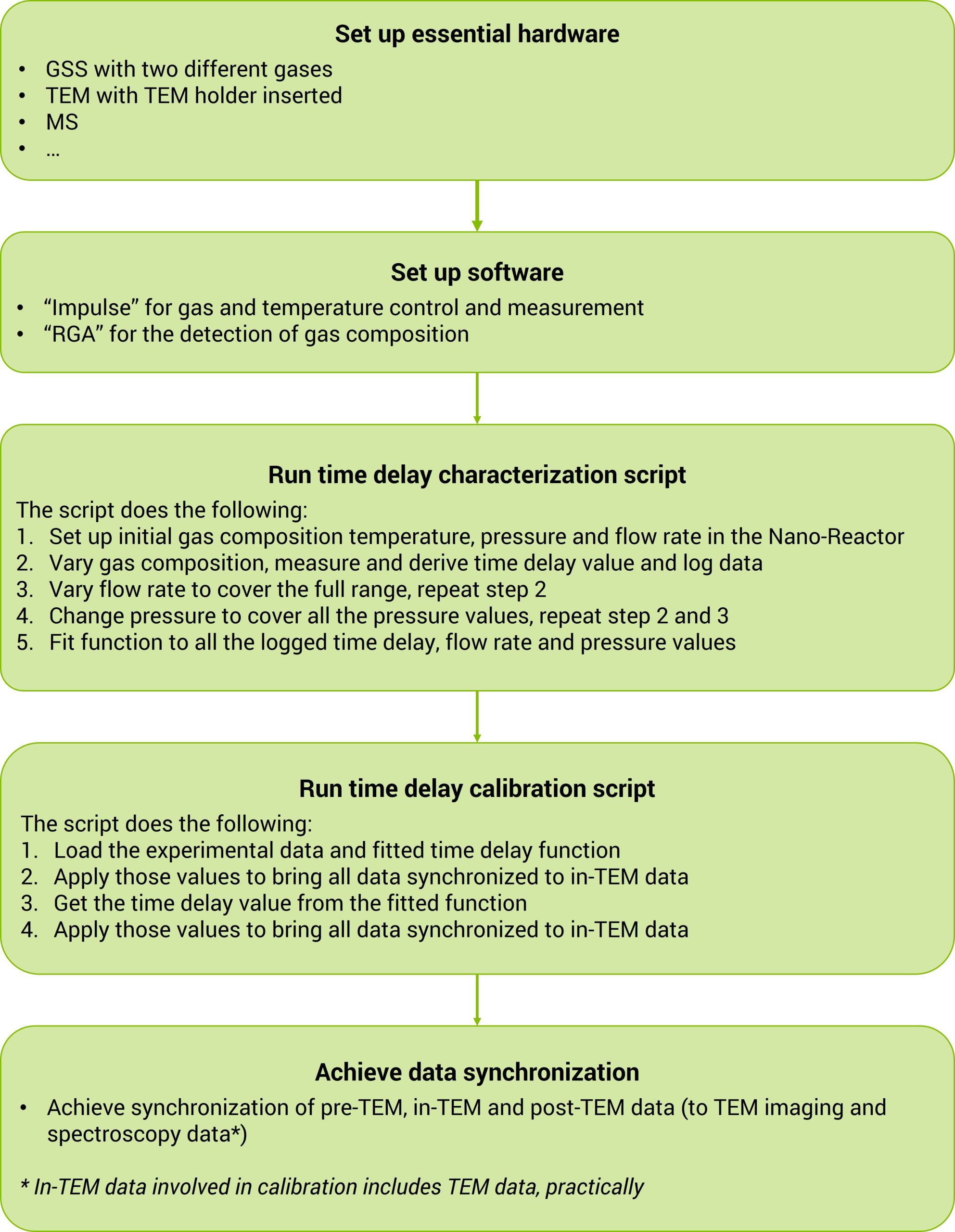
With the above conclusions and scripts, the authors have created a step-by-step guide for performing automatic time delay calibration for your own operando TEM setup. This protocol is summarized in Figure 4 below.

Figure 4: Schematic view of the operation protocol.

Conclusion

Time delay is an issue inherent to every gas supply system used in an operando gas and heating TEM setup. In a collaborative effort between DICP and DENSsolutions, the researchers have developed a data synchronization method to effectively address this problem. Specifically, by developing a functional relationship between delayed time and reaction conditions like gas pressure, flow rate and gas composition, the authors were able to develop open source scripts that characterize and calibrate the time delay automatically. On top of this, a conductive protocol is described such that any researcher can apply the data synchronization method to their own unique operando gas and heating experimental setup. Overall, this work is a major step forward in ensuring that researchers conducting operando gas and heating experiments are able to make valid correlations between critical parameters and provide the right conclusions and insights.

“The DENSsolutions Climate system is able to create an accurate working environment of what practical catalysts go through. Not only does the system facilitate the real-time observation of dynamic catalytic behavior, but it also enables the simultaneous monitoring of the performance of a catalyst by detecting the resulting products within the Nano-Reactor. By enabling this elaborate strategy of data synchronization in operando gas and heating TEM, Climate initiates the distinct functionality of correlating catalytic property with microstructural changes, which adds core value to what the technique of in situ TEM can reveal about a dynamic reaction.”

Prof. Dr. Wei Liu
Professor  |  Dalian Institute of Chemical Physics, CAS

Original article:

Discover our Climate solution:

Discover more publications made possible by Climate:

Thomas article feature image

Scientists explore complex metal-support interactions under redox conditions using our Climate system

Via the DENSsolutions Climate system, a team of scientists uncover the dynamic interplay between platinum nanoparticles and titania support under reaction conditions.

Subscribe to our newsletter to stay up-to-date with the latest in situ microscopy news.