In situ heating TEM speeds up the characterisation process for Aluminium alloys exposed to in-service conditions

In situ heating TEM speeds up the characterisation process for Aluminium alloys exposed to in-service conditions

Original article by Jonas Kristoffer Sunde, Sigurd Wenner and Randi Holmestad

Introduction

Aluminium alloys are versatile lightweight materials exhibiting high strength that will have an increasingly more important role to play in the development of sustainable transportation alternatives, such as in automobiles. Put simply, if you have a lighter car, you need less energy to move it forward. This leads to improvements in fuel economy and reduced-emissions, or one can travel further with a single battery charge.

Aluminium is the fastest growing material for automotive applications as compared to other competing materials, which is driven by stricter regulations and demands to cut carbon dioxide emissions.

Compared to steels, aluminium alloys are much less heat resistant. This becomes an issue when placing components made of aluminium in proximity of sources of heat, such as internal combustion engines or near the battery pack of electric vehicles. If given sufficient amounts of time, the microstructure – and hence properties – of an aluminium alloy will change if exposed to elevated temperatures, say 50-90 °C, which are temperatures that are reached near working car components. Therefore, replacing steel components with lighter aluminium alloy substitutes means that we need to have a fundamental understanding of the behaviour of aluminium alloys under in-service conditions. Additionally, the process of material-joining might entail welding, causing thermal spikes that could reach 300 °C and the formation of heat-affected zones in adjacent materials, which has a large effect on the structural integrity of joint materials.

In situ TEM heating

It is in the understanding of these effects that in situ TEM heating will play a crucial role. Conventionally, samples are heated ex situ to different stages and subsequently inspected one by one in the TEM. However, now Sunde et al. were able to directly observe the microstructural changes occurring on the nm-scale for an Al-Mg-Si-Cu alloy inside the TEM, as it was heated in the range 180 – 240 °C, enabled by the DENSsolutions Wildfire system.

6xxx series aluminium alloys

There are several different classes of aluminium alloys. The main groups of high-strength, heat-treatable alloys are the 2xxx (Al-Cu), 6xxx (Al-Mg-Si) and 7xxx (Al-Zn) series. Of these, the 6xxx series have proved most promising for future use in certain car components due to their general ease of extrusion and welding as compared to most 2xxx and 7xxx series alloys.

Previous in situ heating TEM studies have been conducted on 2xxx type alloys. The 2xxx series alloys lend themselves very well for visualisation in annular dark-field (ADF) STEM mode, due to the increased atomic column scattering power to higher angles for Cu as compared to lighter elements such as Al, Mg and Si. ADF-STEM mode imaging is less suitable for 6xxx series alloys, where the Cu content is usually very low compared to 2xxx series alloys. This requires different TEM techniques for tracking the character of forming phases.

To solve this problem, in a previous study, Sunde et al. developed a characterisation technique using scanning precession electron diffraction (SPED) and machine learning with which one can track the character of individual precipitates acquired from a larger 2D scan area. Here, this approach was combined with in situ heating, which enabled the researchers to track the phase transformation occurring for many precipitates in a single region of interest after exposure to different stages of heating.

Evolving phases

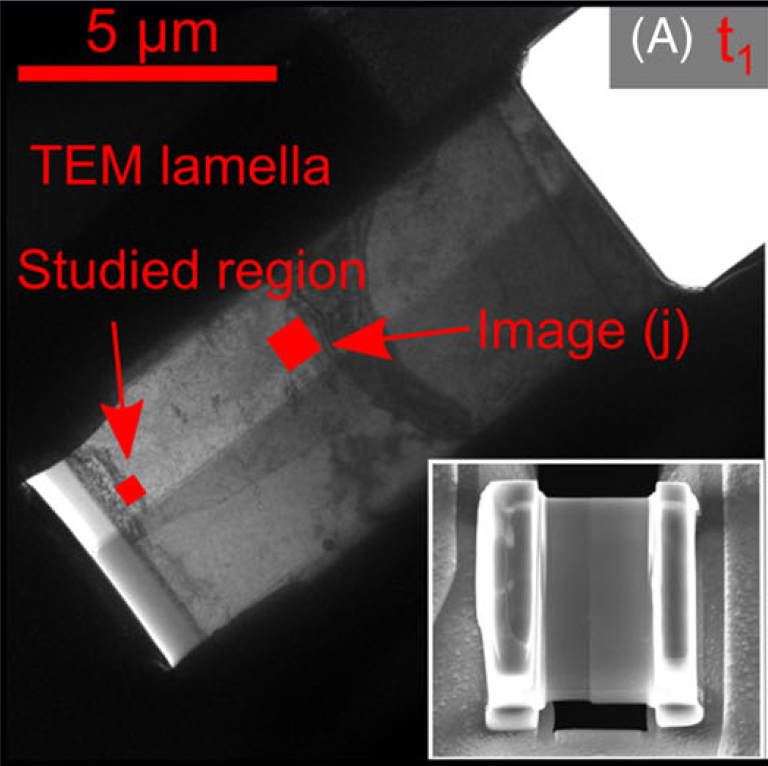
Fig.1. (A) TEM image of the FIB prepared lamella. Insert shows a SEM image of the ion-milled lamella mounted across the heating holder SiN window using a C-weld. (B) A schematic of the heat treatment procedure.

Fig. 2. (A–C) Phase maps constructed from SPED scan decomposition results. The inserts show decomposition component patterns matched with indicated phases.

For this in situ heating study, a FIB lamella of a [001]Al oriented grain was prepared and mounted on a DENSsolutions nanochip. Before this, the specimen was heat-treated ex situ to initiate the precipitation in bulk conditions. Bright-field TEM imaging was used to track the precipitate growth after different stages of heating, and the character of individual precipitates was determined by SPED, performed with a step size of 1.52 nm and a pixel exposure time of 40 ms.

The SPED datasets were analysed and resulted into phase maps which allow one to distinguish respectively ꞵ’’, L and ꞵ’/Q’ phases. It was shown that a few % of initial ꞵ’’ phases transformed into ꞵ’/Q’ phases with heating. The structure of L phases did not change, and the phase exhibited a large thermal stability, with most phases remaining after multiple stages of high temperature heating. This latter finding has very interesting implications, as it might be possible to develop alloy compositions and heat treatment procedures which optimise for L phase precipitates, and which could hence yield large improvements in the thermal resistance of the alloy.

Future research

As can be seen in figure 1 A, bright-field images were acquired from two areas in the specimen. The studied region can be seen in figure 3 C-I and the second imaged region can be seen in figure 3 J. To the researchers’ surprise, the second region (fig. 3 J) shows a very dense microstructure of precipitates compared to the sparsely populated region at the same heating stage (fig. 3 I). The material thickness is slightly different, 130 nm compared to 90 nm. The question now is, what created this difference? This must be better understood in order to increase transferability to bulk precipitation behaviour.


Fig 3. (C–I) Bright-field images acquired at indicated times (tx) in the region highlighted in image (A) (∼90 nm thickness). White and yellow arrows indicate L and (β’’/)β’/Q’ phases, respectively, that remain in the studied region after all stages of heating. The white dashed oval highlights coarsened precipitates that have formed on an underlying dislocation, and acts as a point of reference between images. (J) Bright-field image acquired in the indicated region of image (A) (∼130 nm thickness).

“Our research group has been studying the needles of the Al-Mg-Si(-Cu) system for a very long time. Now that we are able to watch them grow and transform inside our microscopes, thanks to the DENSsolutions heating system, we can put our ideas to the test, and build bridges across current gaps in our knowledge. Exciting discoveries lie ahead!”

PhD candidate. Jonas Kristoffer Sunde – Department of Physics, Norwegian University of Science and Technology (NTNU)

Learn more about our Wildfire system and Nano-Chip:

Discover more publications made possible by our Wildfire system:

Read the original article:

Do you want to receive great articles like this in your mailbox? Subscribe to our newsletter.

Uppsala University in Sweden expands its TEM capabilities using DENSsolutions In Situ systems

Uppsala University in Sweden expands its TEM capabilities using DENSsolutions In Situ systems

A DENSsolutions Wildfire double tilt (DT) system with a biasing expansion has been installed at the Uppsala University, Sweden.

Sharath Kumar Manjeshwar Sathyanath and Lars Riekehr checking the new Wildfire holder.

“It will be mainly used by the solid state chemistry group in order to investigate temperature behavior of alloys ”


Lars Riekehr – senior research engineer from the Ångström Laboratory in the Department of Engineering Sciences at Uppsala University.

Applications

The Wildfire DT system will be used by the group to research the phase transitions in metals and solar cells.

“After the installation the system was directly tested using solar cell samples. The researchers wanted to see how chemical inhomogeneities in the absorber layer would behave upon heating.”

In particular, Riekehr is pleased with certain features of the Wildfire system, such as the extra lateral shift on heating, the bulging and the stability. Additionally, the Biasing expansion will allow for precise operating voltage control.

He added that he was looking forward to the prospect of being able to offer in situ experiment results to anyone in the department who might need them.

Thank you for reading

To learn more about our Wildfire system:

Do you want to receive great articles like this in your mailbox? Subscribe to our newsletter.

Interview with Prof. Angus Kirkland, Science Director at the new Rosalind Franklin Institute, UK

Interview with Prof. Angus Kirkland, Science Director at the new Rosalind Franklin Institute, UK

Prof. Angus Kirkland visiting the DENSsolutions laboratory. © 2019 DENSsolutions All Rights Reserved

We interviewed Prof. Angus Kirkland, Professor at the Department of Materials, University of Oxford and the science director at the Electron Physical Science Imaging Centre (EPSIC), Diamond Light Source UK. We talked about the new Rosalind Franklin Institute where he performs disruptive research projects in life sciences involving physical science methods, techniques, and instruments including In Situ TEM and correlative imaging.
We discussed his research with colleagues at UCL involving Brownian tomography and with colleagues in Oxford looking at defect dynamics in low dimensional materials like graphene. With his diverse experience in TEM, Kirkland discusses cutting-edge ideas on future advancements in liquid-phase electron microscopy (LPEM) and examines the way that TEM research and big data mining are becoming intertwined.

“What we would like to ultimately aim for is to be able to image important biological structures in their native environment; so in aqueous solution at about 37.5°C, while interacting with other biological structures or pharmaceutical compounds with timing resolutions of about a microsecond. ”

How did you get involved with In Situ TEM research?

Well, I originally got involved in TEM research because my PhD was looking at the structures of small metal particles and any broad beam technique at that time just simply gave you structural averages. So, the only obvious methodology was to use a microscopy-based technique and TEM was the obvious choice. So, I got heavily involved in high-resolution TEM as part of my PhD.
I then spent a lot of time developing methods for TEM, including super-resolution methods, and we got back into In Situ TEM when I moved to Oxford because we were then interested in mapping the phase diagrams (the structural changes as a function of temperature and size) for small metal particles. So, we contacted DENSsolutions in the very early days when there were only a few people working here, and we purchased one of the very early In Situ heating holders and published some very nice papers on the phase diagram for nanogold.

How did the DENSsolutions system aid your In Situ research?

The DENSsolutions system gave us much better drift stability and temperature control than any other product in the market. We would take a small gold particle and map out how its structure changed as a function of temperature very accurately, or we could take particles of different sizes. So Dr. Neil P. Young, University of Oxford, UK, and I actually mapped out the phase diagrams experimentally and compared them to theoretical calculations, done by Dr. Amanda Barnard, CSIRO, Australia, of what the predicted phase diagram would be. And they mapped almost perfectly.

DENSsolutions Wildfire drift stability

Did this research make changes in industry?

This was a critically important problem for the catalysis industry because gold is used for carbon monoxide oxidation as a catalyst. The catalysis industry would like to know: if we have a gold particle of a certain size; what’s its structure, then what’s its surface structure, and what’s its catalytic activity? And the traditional way is to do lots of experiments; you would measure thousands of particles experimentally which takes time.

Fig. 1. Various shapes exhibited by gold nanoparticles: the Mackay icosahedron (a), the Ino (b) and Marks (c) decahedra, the symmetrically twinned truncated octahedron (d), the ideal truncated octahedron (e), and the ideal cuboctahedron (f).

Reprinted with permission from Barnard et al, Jun 2, 2009, ACS Nano, doi.org/10.1021/nn900220k. Copyright 2009 American Chemical Society.

Fig. 2. Quantitative phase map of gold nanoparticles, based on relativistic first principles calculations.

Reprinted with permission from Barnard et al, Jun 2, 2009, ACS Nano, doi.org/10.1021/nn900220k. Copyright 2009 American Chemical Society.

What they do now is they take our phase diagram (Fig. 2.) and they say: so if it’s 30 nm at room temperature it will have this shape. So, they can use it as a predictive tool to understand how best to optimise their catalysts. I’m very proud of that paper because it means that industry doesn’t have to do thousands of experiments. They can take one diagram and use its predictive power. link1 link2.

Which other In Situ TEM solutions from our company have you been using?

I’ve got a student at the moment, he’s actually the Rhodes Mandela scholar in Oxford, and he’s been looking at Fischer Tropsch catalysts which are complicated cobalt or iron metal-and-metal oxide systems. We’ve been using the DENSsolutions Climate system extensively to do In Situ Fischer Tropsch catalysis and mapped that data back onto the very large studies that have been done ex situ to verify that the ex situ studies and the ex situ microscopy are correlated.
Most recently, I have become very interested in liquid cells for developing imaging methods to look at biological macromolecules and biological structures In Situ in liquid environments rather than in frozen and vitrified ice. That’s a driver in the new Rosalind Franklin Institute for which I am one of the science directors.

Artist impression of the new Rosalind Franklin Institute.

Can you tell us about the Rosalind Franklin Institute?

The original concept for the Rosalind Franklin Institute was initiated by Sir John Bell at Oxford University. A team of people were assembled across different disciplines, including myself, to set up the initial science themes. At that point, I was invited to lead the theme ‘Correlated Imaging’. We had to write the science case, that was peer-reviewed, then we had to write the business case that was also reviewed by government, and then it was funded, so I was involved from day one.
The Rosalind Franklin Institute’s main mission statement is to “translate physical science methods, techniques and instruments across the boundary into life sciences and medicine.” To do this I had to learn very quickly a bit of biology “101” and start understanding life sciences. So, that’s why I got interested in life sciences. I’m a chemist/physicist by background and now I have the unique opportunity to take all that I have learned and apply it to the field of life science.

Is this also how you got interested in liquid-phase electron microscopy (LPEM)?

Yes, absolutely. One of the things that we will be doing in the Rosalind Franklin Institute with the liquid cell developments is trying to apply some of the methods that we conventionally use in vacuum into the liquid state. So, we’ve developed a lot over the years; various phase retrieval methods, including ptychographic experiments and we’d like to try all of those, not in vacuum, but in the liquid state.

Images acquired by Brownian tomography by UCL.
Brownian tomography (developed at UCL by Prof. Giuseppe Battaglia and his group), is a powerful technique that can be used to reconstruct a 3D model without tilting the holder. This is one of the techniques we would like to apply but there are also other experiments which we know how to do in a vacuum and we’d like to see how they translate into the liquid state. This will give us extra additional information that we otherwise wouldn’t have had.

Which of the projects inside the Rosalind Franklin Institute are you most excited about?

The Rosalind Franklin’s mission is to do disruptive science. What we would like to ultimately aim at is to image important biological structures in their native environment, so in aqueous solution at about 37.5°C, while interacting with other biological structures or pharmaceutical compounds with timing resolutions of about a microsecond. So, making million-frames per second movies of images of biology in action: That’s the moonshot.

For this, we need further developments in liquid cell technology. We need MEMS devices holding liquids at body temperature very accurately where you can actually flow in, for example, a saline solution or a sugar solution, or even a dilute solution of a pharmaceutical compound. In order to do anything meaningful in this field we have to have incredibly low drift rates, we have to have very accurate flow control and we have to be able to deal with liquids that are slightly viscous so that’s an engineering challenge in itself, and finally, of course, we have to have accurate heating control.
Basically, we’d like a liquid cell that mimics the human body.

What is needed to reach this goal?

There’s a lot of engineering to be done in terms of not only the liquid cell holder development but also in terms of the instrumentation to give us the very fast beam blanking and the new electron optical columns that we’re going to need. We have JEOL as a partner to do that with. Next, we also need to think carefully about how we’re going to manage and mine the data because we’re going to generate huge quantities of data very quickly, finally we have to upgrade and develop a new generation of electron detectors.
So: engineering, detector physics liquid cell development and electron optics all need to be advanced.

How will other collaborators, like DENSsolutions, contribute to the research?

In terms of liquid cell development, we need a reliable commercial manufacturer like DENSsolutions because we don’t do the precision engineering and the MEMS design. The column optics and the fast shuttering will be done by JEOL and partners who specialise in that area.

The team we will need to put together internally is going to be a combination of engineers and scientists and computational and data scientists for managing the data. We will almost certainly need to hire some theorists to deal with the necessary algorithms that we have to develop, for example, for aligning and stacking the data.

We will of course need to have biologists in that team to identify some really relevant early biological problems that we can tackle. So the whole point of the Rosalind Franklin Institute is to assemble these very multidisciplinary teams all attacking one big long-range problem.

Prof. Kirkland together with our CTO Dr. Hugo Perez. © 2019 DENSsolutions All Rights Reserved

Do you see a merging of materials science and life science happening?

Yes, this is one of the things we have already found at the national centres. We have two national centres, one in physical sciences and one in life sciences (ePSIC and eBIC), and it’s the former that I direct. Because we have life scientists and physical scientists already sitting in the same building on adjacent desks, we’ve already found that there’s been a huge collaborative interaction between them.
So, there’s been a really nice convergence of our interests and that’s actually led to a couple of very nice experimental programs which we wouldn’t have thought about without their input. We’ve got a couple of publications going through at the moment with some new data.

Can you tell us something about your recent work?

I guess that most of the work that I’ve been doing recently has been in the materials science sector. I have had a very fruitful and successful collaboration with Prof. Jamie Warner in Oxford looking at defect structures in low dimensional materials link. We started with graphene, we looked at silicon nitride, we looked at various disulphides and that’s produced a string of very high impact papers over the last seven years or so.
The other paper we’re proud of, which unfortunately doesn’t involve In Situ at the moment, was that we solved a very old problem, in collaboration with Nelson Mandela University in South Africa. This was a fifteen-year-old problem that hadn’t been resolved: the structure of nitrogen-containing-platelets in natural type 1a diamonds. Natural type 1a diamonds have nitrogen-containing inclusions and the structure of those platelets has been a controversy that has been unresolved for the last fifteen years or so. We finally, unambiguously, determined which of the four models that have been proposed was correct link. So that was a very satisfying piece of work.

Which of your work was enabled by DENSsolutions In Situ systems?

Most of the In Situ work that we’ve done, in which we used the DENSsolutions Wildfire system extensively, has been looking at variable temperature defect formation and migration in these low dimensional materials.

Fig. 3. (a)-(c) TEM images of holes in graphene at room temperature.

Reprinted with permission from Kuang He et al, April 16, 2015, ACS Nano, doi.org/10.1021/acsnano.5b01130. Copyright 2015 American Chemical Society.

One of the earliest things we did with the early DENSsolutions heating holders was to suspend sheets of graphene across FIB holes in the heating element and look at how defect dynamics changed as a function of temperature. So the In Situ part, i.e. the precise temperature control, was very critical. We are now extending that research with very fast detectors to look at much bigger data sets to try and extract the chemical kinetics of these defect formations and transformations.

What do you expect from DENSsolutions in the future?

I know that you are ahead of the game when it comes to the next generation of liquid cells and you already have a huge amount of technology that we’re going to need. It’s a question of maybe expanding that a little bit in certain key areas. I think the other thing we’d like, and this is something applicable to all the manufacturers, is to be able to move the specialist end components of the holder, the sample carrier, from an electron microscope for example into an X-ray beamline or an optical microscope.

We would ideally like a common platform standard so that we can move the same system between instruments because I think there is a huge amount of interesting correlation studies that can be done if you can image the same sample using lots of different imaging instruments. We would like to modularise the holder still further so that we’re not reliant on a specific type of TEM rod. If you could provide the In Situ platform which we can use in any correlated imaging workflow, that would be incredibly powerful.

How is your research influenced by societal problems?

Within the Rosalind Franklin Institute, it’s a core part of our mission because we’re translating physical science into life sciences and medicine, so a lot of the problems that we will attack are going to be pulled or pushed by clinicians and people working in medical research who need specific kinds of information.
For example, there are people with cancer who are treated with cisplatin drugs which are platinum-containing organometallic compounds. The problem is that sometimes people get a very acute pain when they have this type of chemotherapy and the questions are “why do they get the pain? Where does the platinum go?” This is a clinical problem that’s currently being explored using electron microscopy, which is a physical science method.

Stock photo, medical research

So Prof. Peter Nellist, University of Oxford, UK, and his student Alex Schreader are looking at the cellular distribution of the platinum after the treatment in collaboration with King’s College London. We want to see where the platinum goes in relation to the cellular context, and does it differ for different drugs, for different types of patients, for different stages of treatment? There are lots of good medical problems that can be solved with electron microscopy but, of course, if you want to do anything medical which has a societal benefit you really have to do it In Situ in as close to a native state as possible.
The problem is that the native state isn’t ultra-high vacuum in an electron beam, it’s in a liquid environment or possibly a frozen environment. So that’s where the In Situ part becomes really relevant. Otherwise, it’s very hard to verify if what you see in ultra-high vacuum conditions is relevant to physiological environments.

Which recent publication wowed you in the field In Situ TEM, outside of your own research?

If I’m thinking about In Situ work, the publications that I’ve found most impressive are the In Situ experiments where people actually put real devices into the microscope and bias them and see how, for example, doping contributions change, how electric fields change. Here, you actually get a very accurate structural and chemical picture of a real device in operando.
You can observe, for instance, a genuine PN junction, bias it, and see how the field changes and where the dopants move to. It was nice to see these images, you look at the field lines and images and they look exactly like the textbook diagrams. There are a few groups doing this kind of work, for example the group of Prof. Raphal Dunin-Borkowski, ER-C Jülich, Germany, and Dr. Martin Hytch, CEMES-CNRS, France. 
Other In Situ work that comes to mind is that of Prof. Frances M. Ross, DMSE, MIT US, who has done a lot of In Situ work looking at vapour-liquid deposition of various nanowires. She’s got fantastic movies of nanowires with gold caps at the top, showing nanowires growing out of a substrate and making forests link.
She’s also developed all the maths and calculations to work out the growth kinetics as a function of precursor concentrations.

What are some of the advantages of working In Situ?

An advantage of the In Situ work is really all about being able to model and visualise the formation of structures. So, you can put the component parts together in their natural environment, whatever that might be; a chemical environment, a gas environment, a liquid environment, and actually see how they assemble themselves into the final composite device. So, you’re actually seeing how things form rather than just looking at the post mortem structures in vacuum after they form.
An important part of the work is building models that predict how these would form so you can change components of that model building process and show how different structures would arise. In this way you can develop some sort of relationship between the component parts and the final structure and the final property which tailors your devices. So that’s where we and others are heading for.

What will be the big challenges for TEM research overall in the coming years?

I think one challenge for electron microscopy in the next few years is going to be the big data challenge. We’ve scaled up over the last few years from megabytes to gigabytes and now to terabytes, we’re now hitting the many-terabytes or even hundreds-of-terabytes limit, and in some areas towards petabytes. Then the whole data problem changes.

This is driven, in part by an increasing time resolution. With current detectors, for our graphene-defect work, we routinely feed into a neural network, developed by Dr. Chen Huang, one of my postdocs over one-and-a-half to two million images taken in one session. So, whereas one-and-a-half to two million images might be the total output from a research group in ten years, now it’s half a day. So were generating vast quantities of data.
The challenge is not just about storing it and archiving it, it’s actually about mining it. How do you extract the information you want from these very large datasets? It is clear to us that you can’t do that manually, so you have to turn to machine learning and artificial intelligence. So Chen has spent a lot of time recently developing AI and machine learning applied to specific EM problems with these large datasets.

Thank you for reading

To learn more about our LPEM system:

Do you want to receive great articles like this in your mailbox? Subscribe to our newsletter.

Interview with Prof. María Varela del Arco, GFMC, Complutense University of Madrid

Interview with Prof. María Varela del Arco, GFMC, Complutense University of Madrid

Prof. María Varela del Arco behind the JEOL ARM200F transmission electron microscope.

We interviewed Prof. María Varela del Arco, who is in charge of electron microscopy in the group GFMC at the Complutense University of Madrid. We talked about her research on, among other topics, magnetic materials and supercapacitors that was made possible by the DENSsolutions Lightning system, and interesting developments in big data mining. Her passion for tackling societal issues helps her bring the relevance of her research into a wider context than the nanoscale.

“In the end, all of the research we do is aimed at improving technology and energy efficiency. We want to find better and cheaper energy materials or cathode materials for batteries, for instance. ”

Who are the scientists that make up your research group?

Our research group is part of the School of Physics. We work in condensed matter and materials physics. I am part of a relatively large group including approximately 10 permanent staff members with different expertise. We use a number of techniques: growth of thin films, magnetometry, characterisation of physical and transport properties and of course electron microscopy, which I am in charge of working together with two other permanent professors.

Members of the GMFC research group. From left, Prof. María Varela del Arco, Dr. Neven Biskup, Mariona Cabero Piris and Dr. Juan Ignacio Beltrán Finez.

We also count on a theorist who does simulations in order to help us with the interpretation of data and the design of new experiments. So it is a quite comprehensive way of addressing the understanding of multiple materials problems of relevance. In fact, a major strength of our group is that we can address any given problem in materials physics from many perspectives simultaneously.

Which fields do you tackle in your research?

We mainly work in magnetic superconducting materials link1 link2, functional materials link, ferroelectrics link and materials for energy like ionic conductors and such. We are trying to really understand the properties all the way down to the atom and the atomic configuration. Not just by looking at the static electron microscope image but also under different physical conditions. This way we can actually give an interpretation from many points of view simultaneously and really get to understand the whole physical mechanism responsible for any macroscopic behaviour of interest.

At the time being, we measure physical properties such as transport properties out of the microscope with a number of cryostats to measure all temperature properties and ionic conductivity, also at high temperatures. We also have lithography means so we can fabricate devices like electronic or spintronic devices. We do all these kinds of characterisation on the samples ex situ, but we would also like to do that in situ, inside the microscope.

How will your team implement In Situ capabilities in your lab?

We have a big expertise in the group on transport itself. We can measure the DC and AC transport properties. So it will be cool to bring our equipment into the microscope room, connect to the TEM holder, apply a bias and measure the properties while we’re watching. Maybe we’ll see a sort of electromigration, drifting vacancies like oxygen vacancies in oxides, field-effects across interfaces or injections of charge or spin going from one material to the other.

We are doing these kinds of things right now in the lab but we want to perform them inside the microscope while watching. That is our objective in the very near future. It’s not easy, it’s definitely very challenging, but we are really passionate about giving it a try.

Sample preparation. From left, Prof. María Varela del Arco and graduation student Gloria Orfila Rodriguez.

How did you get passionate about In Situ TEM research?

My early years of training was not in microscopy. On the contrary, I was mainly working in thin film growth link1 link2 and characterisation of transport, particularly in superconducting thin films. I’ve always been very interested in the atomistic properties underlying the macroscopic physical properties of materials systems. So, when I got into transmission electron microscopy I was able to combine this curiosity with my ex-situ expertise in order to really understand what may be going on in the material and how properties arise.

In situ TEM allowed me to add an additional dimension and measure nanoscale phenomena in real time. For example, think of device characterisation. In the lab, sometimes we broke an electric contact while measuring e.g. tunnel junctions. Maybe we applied too high a voltage bias or changed temperature way too fast and we never really knew why this was happening. Now in the TEM, by running in situ experiments, you can record the process and watch in real space actually how a contact breaks… or not!

Complex phenomena such as metal electromigration might happen, which would definitely cause device failure. Perhaps other chemical species or defects might migrate. One way or another, I always wanted to characterise such processes in a controlled way, to be able to watch phenomena at work way beyond looking at a static picture of a material or trying to infer mechanisms from blind measurement of resistivity or other transport properties.

Being able to study transport in real space and monitor carriers moving around, for example, in ionic conducting materials link1 link2, holds the key towards harnessing nanoscale functionality in these systems, opening up a massive universe of exciting possibilities.

Lightning D9+ JEOL Sample Holder tip.

Which new interesting things did you find using our In Situ TEM solutions?

We initially procured the DENSsolutions Lightning system mainly to electrically bias materials systems in situ. It was also capable of heating of course, which added potential applications although our research mostly takes place at lower temperatures – we often work with magnetic materials or superconductors which are functional systems that develop their properties well below room temperature. The initial stages of our in situ research consisted mainly in running experiments using the Lightning at different temperatures aiming at mastering the technique, the software, checking stability, etc. While doing so really cool phenomena started taking place in front of our eyes. This opened up a lot of questions which made us drift more into the heating part of the experiments. Heating experiments can also be a bit more simple from the point of view of sample preparation.

An example can be found in a recently published paper in collaboration with the University of Valencia, which has focused on harnessing magnetic nanomaterials used for supercapacitors. Nanocomposites made of iron, nickel and graphene were cycled hundreds of times up to 400 °C, under a magnetic field. A very strong segregation of iron and nickel was induced during the process. Iron gets oxidised which results in inhomogeneous core-shell systems. The behaviour observed was absolutely unexpected. Now, the resulting nickel – iron oxide interfaces exhibit a very high electrochemical activity, and the fact that the volume fraction of interface regions is massively increased enhances the capacitance of the system by hundreds and hundreds of times.

This is a very interesting finding because typically when electrode materials are cycled more often than not their properties are degraded. However, in this case, this high specific capacitance was actually increasing during cycling! The property of relevance actually gets better over use. This is completely the opposite of what usually happens in relevant applications such as batteries like the one in your smartphone. Their performance and behaviour gets increasingly worse the more you cycle them and in the end you need to either change the battery or buy a new phone. Well, it was exactly the opposite, and all of the understanding came could from the in situ TEM. Furthermore, this finding opened a whole new front of possibilities with different nanocomposites and materials that are sensitive to magnetic fields or other driving forces that can make the system segregate with varying temperatures in order to actually optimise any new properties. At the end of the day, it is these unexpected things that you run into that can sometimes be a lot more relevant and stir up a research field.

FIB sample preparation guidance video.

What are some of the bottlenecks you come across during your research?

One of the main bottlenecks we find is related to specimen preparation for electric biasing experiments. Particularly for the kind of samples that we grow here in the group: heterostructures or superlattices and thin films. Most of the functionality that we are interested in typically arises upon biasing in the form of applying a field across the interfaces. This might result in electroactive systems, colossal magnetoresistance, or real fancy phenomena and functionalities to exploit in a device. So in order to bias, measure and simultaneously observe a specific geometry is needed when it comes to sample preparation. For this you need not just a FIB system but also a very good FIB operator who can produce a very clean lamella, mount it and contact it on the chip in the right orientation and end up having a sample clean of contamination. When running transport properties surface contamination can be a killer. Electric conduction could place on the surface instead of through the device and measurements will be impossible to interpret correctly.

So at this point really refining a reliable method for this particular kind of preparation constitutes a major challenge and a major bottleneck for us at this moment. The Lightning system is really very flexible, the geometry is really easy to work with and it gives us the freedom to design many different kinds of measurements. The challenge really resides in the sample.

What do you expect from DENSsolutions in the future?

What I would really like to have for Christmas is new developments related to low-temperature capabilities. Like I explained before, many of the relevant functional materials that we are working with of interest for spintronics and oxide electronics, exhibit properties of interest at low temperature ranges, be it magnetism or be it superconductivity. So if we really want to study any sort of electronic phenomena like transport across an interface or ferroelectric polarization under bias it is highly desirable to do it within the relevant temperature range. Maybe liquid nitrogen would be enough to start with?

Ceramic superconductor cooled by liquid nitrogen.

For example, many high-temperature superconductors are superconducting over 77 K. Yttrium barium copper oxide (YBCO) for example becomes superconducting at 92 K. It’s not so difficult to get a material to achieve the superconducting state in a microscope. Actually, the old cooling holders that we’ve had for years manage to get down to 90 degrees in liquid nitrogen rapidly. Of course, they have terrible spatial drift and stability so that would be the main issue to tackle but I’m sure that the DENSsolutions team can figure this out. The current wonderful thermal stability at high temperatures all the way up to 1000 °C allows watching nanoparticles evolve for minutes with a total lateral drift of less than a nanometer, so why not dream of doing the same thing at 100 K, or below?

How is your research connected to societal issues?

Addressing societal issues constitutes the most important drive for us, even if we work in basic research, which in general is not directly linked to an actual application. In the end, all of the research we do is aimed at improving technology and energy efficiency. We want to find better and cheaper energy materials or cathode materials for batteries, for instance. Also, we strive to develop materials for faster electronics and multi-functional devices capable of actually controlling a relatively large number of degrees of freedom with a relatively small amount of energy externally provided. You could have a faster computer that requires less power to run so energy would be saved worldwide or that the developing countries will have access to cheaper, reliable technology and therefore people will have access to better means and services, such as medical machines. Superconductors, for example, are an important part of MRI technology. And at the end of the day, I’d really like to think that these new materials we discover and the resulting advances end up making somebody’s life easier, cheaper and more secure

At the moment what other In Situ TEM research excites you outside of your own workfield?

Well, actually what really excites me outside my field at the moment is something closely related to in situ TEM research. The situation that we are running into now that we have all these wonderful holders, manipulators and samples combined under the electron beam, is that we are getting to the point that we are acquiring gigabytes and gigabytes of data in every session. Data which may become very difficult to analyse because these large volumes need to be quantified in order to extract any meaningful information, especially if you wish to extract statistically significant information from atomic-resolution electron microscopy.

Lack of statistics is a problem of high-resolution microscopy: we analyse really small volumes within our samples. You basically land on some position of your system and hope that this area is representative for the whole device. So in order to make sure that things in the end are representative you really need to analyse lots of regions in lots of samples and now with the in situ capabilities we are really up to the point that massive amounts of data will be generated, for example when you record movies or spectrum images.

So right now the newly emerging data processing techniques related to big data are very interesting, like applying artificial intelligence for example, to the quantitative analysis of microscopy data. Imagine we could end up realizing this dream of high throughput microscopy: recording movies, analysing process evolution under the electron beam and almost at the flick of a switch extracting meaningful information on the fly, without having to go into the office and wait for 2 months analysing noisy data. Imagine being able to extract the relevant physics out of the noise almost as you go while you are running an in situ experiment. That would be really cool.

Do you also collaborate with other TEM groups?

Yes, I was in the U.S. for over ten years before moving back to Spain and I did collaborate with lots of groups there, including not just microscopy, theorists and also growers, from different universities and national labs. I would say that is still a large part of my network of collaborators.

Now, in Europe, we work with a number of groups that we work with on a relatively regular basis. For instance the CNRS/Thales in Paris. They have a very strong spintronics group in particularly oxide-based spintronics which is where we mostly focus on. And we collaborate with groups in Italy, Switzerland, U. K. and others. But many of my European collaborators these days are excellent growers.

Perhaps I used to collaborate with microscopists a little bit more often in the past. It was back in the time, in the beginning of aberration correction when a lot of technique development was taking place and facilities were more scarce so it wasn’t easy for a given lab or group to have all of the equipment available. For example there was this collaboration with Robert Klie from the University of Illinois, in Chicago. He had a low T, liquid helium holder so we could actually run the first experiment testing the sensitivity of spectroscopic fine structure to spin by measuring the spin transitions while cooling down and warming up perovskite cobaltites link1 link2. Collaborations like this used to happen but now it seems like we can do a lot of the work in-house thanks to the local availability of advanced equipment.

Still, for example in Europe we also have joint projects with SuperSTEM at Daresbury since they have this wonderful monochromated Nion microscope, or with TU Darmstadt regarding in situ biasing. So we try to keep a strong network of international collaborators on all fronts.

Thank you for reading

To learn more about our our Lightning system:

Discover Lightning related publications:

Do you want to receive great articles like this in your mailbox? Subscribe to our newsletter.

Improved insight into catalytic reduction of NOx for industrial processes

Improved insight into catalytic reduction of NOx for industrial processes

In Situ TEM supports the design process of a new nanorod catalyst

Original article by Zhaoxia Ma, Liping Sheng, Xinwei Wang, Wentao Yuan, Shiyuan Chen, Wei Xue, Gaorong Han, Ze Zhang, Hangsheng Yang, Yunhao Lu, and Yong Wang. Published in Advanced Materials, volume 31, issue 42.

Artist impression showing growth of carbon nanotubes via an iron-catalyzed process. © 2019 DENSsolutions All Rights Reserved

There is a big opportunity for the design and development of sustainable catalysts for low-temperature NOx removal in the steel, cement and glass industries. Researchers Dr. Yong Wang et al. from Zhejiang University made a recent breakthrough using critical information obtained by In Situ TEM to design a MnOx/CeO2 nanorod (NR) catalyst with outstanding resistance to SO2 deactivation. Former studies proposed methods which succeeded in temporarily diminishing the influence of SO2 but lost their effectiveness over time. In this study, a dynamic equilibrium was achieved between sulfates formation and decomposition over the CeO2 nanorod surface, resulting in an unchanged NOx reaction rate for 1000 hours.

In Situ TEM study

Up till now, researchers have not been able to see exactly what happens to the CeO2 catalyst particle when exposed to SO2 because SO2 is so corrosive that it would damage the environmental transmission electron microscope (ETEM). Now, thanks to the DENSsolutions Climate in situ TEM Gas and Heating system, scientists can for the first time observe and record this degradation process at the atomic scale. Dr. Wang’s team found out that non-active amorphous cerium sulfates were formed from the reaction between SO2 and CeO2. The cerium sulfates formed a deposit which gradually coated the crystalline surface of the nanorods that was catalytically active.

Video 1. In situ TEM observation of the formation and evolution of cerium sulfate over Ce02 nanorods during treatment in 1000 ppm NO, 1000 ppm SO2, and 10 vol% 02 balanced with Ar at 523K. The two white arrows point to amorphous bumps at the end of Ce02 nanorods.

Video 2. In situ TEM observation of dynamic evolution of cerium sulfates during treatment in 1000 ppm NO, 1000 ppm NH3, and 10 vol% 02 balanced with Ar at 523K. The white dashed circles indicate the amorphous cerium sulfate bumps, which decomposed after the introduction of NH3.

In the first part of the In Situ TEM experiment, the researchers introduced diluted SO2 to study the deactivation behaviour of CeO2. Many obvious bumps were formed on the surface of the CeO2 nanorods (NR); this dynamic formation process can be seen in video 1. After this step, the researchers used their Climate Gas Supply System to switch off the SO2 gas flow to the TEM and switched on the diluted NH3 gas flow. The researchers could then observe the amorphous cerium sulfate bumps to become smaller and finally almost disappear at 523 K. The decomposition of the cerium sulfate bumps can be seen in video 2. This change back to polycrystalline CeO2 can be seen in detail in video 3.

Video 3. In situ TEM observation of dynamic evolution of a single cerium sulfate bump during treatment in 1000 ppm NO, 1000 ppm NH3, and 10 vol% 02 balanced with Ar at 523K. The white arrow points to amorphous cerium sulfates, which retransformed into crystalline Ce02 after the introduction of NH3.

Image 1. DENSsolutions Gas Supply System

The Gas Supply System (image 1) of the Climate G+ gas & heating system can continuously mix (dilute) gas flows from up to 3 sources. The mixing ratios for these 3 gas flows, typically 1 reducing, 1 oxidizing and 1 inert (carrier) gas, can be changed real-time between 0% and 100% according to the requirements of the in situ TEM experiment. This makes it the ideal tool for new discoveries in gas-solid interactions.

“Thanks to the state-of-the-art gas cell system from DENSsolutions, we can simply move the industrial reactions into the TEM and observe what really happens for the catalysts during reactions with atomic resolution at atmospheric pressure. This is the first time we attempted to introduce industrial gases like NH3 and SO2 to the gas cell system. To our surprise, this system was pretty robust and worked perfectly when studying the catalytic reactions involved in SO2 poisoning.”

Dr. Yong Wang – Zhejiang University

Learn more about our Climate system and Nano-Reactor:

Discover more publications made possible by our Climate system:

Read the original article:

Do you want to receive great articles like this in your mailbox? Subscribe to our newsletter.

Queen’s University Belfast joins the group of Climate In Situ users

Queen’s University Belfast joins the group of Climate In Situ users

Dr. Miryam Arredondo-Arechavala (centre) in front of the (packed) Climate system, together with her PhD student Tamsin O’Reilly (left) and her Postdoc Dr. Kristina Holsgrove (right).

At the beginning of October, DENSsolutions installed a Climate G system at the Queen’s University Belfast, Northern Ireland, UK. 

“We are very excited to have the Climate system in-house. It all began about 3 years ago when I started describing these new amazing holders to my colleagues in the Chemistry department. It took some time but couldn’t be happier! We are really looking forward to trying the different experiments that we have been designing for so long… Now it’s time to get to work and hopefully won’t break too many chips on the way!”
Dr. Miryam Arredondo-Arechavala

Applications

The system will be mainly used by Dr. Miryam Arredondo-Arechavala and her group to study ferroelectrics and other functional materials. Alongside this, it will help accelerate research on ionic liquids performed by the QUILL Research Centre (Queen’s University Belfast’s Ionic Liquid Laboratories) and other catalyst projects at Queen’s University Belfast.

The DENSsolutions Climate holder inserted in the Talos TEM for the first time.

The group running the first test experiment using the Climate software.

Installation and first experiment

The system was installed in less than two days by our Climate product manager Ronald Marx. After this, Marx provided hands-on training for the new group of users. The team was able to start their first In Situ Gas & Heating experiment using their own sample of Zeolite particles which was dropcasted on to the Climate Nano-Reactor. Seeing the first results created a lot of enthusiasm among the group of principal investigators and their colleagues from the chemistry department.

Learn more about our Climate system:

Discover publications in which our Climate system was used:

Do you want to receive interesting articles like this in your mailbox? Subscribe to our newsletter.