Our partnership with the EPSRC/Jeol Centre for Liquid Phase Electron Microscopy at UCL, London

Our partnership with the EPSRC/Jeol Centre for Liquid Phase Electron Microscopy at UCL, London

DENSsolutions LPEM systems enable advances in Life Science

Dr. Lorena Ruiz-Perez (left) and Prof. Guiseppe Battaglia (right)

On the 12th of November, DENSsolutions in cooperation with UCL and Quantum Design UK will be holding a Stream workshop at the EPRSC/Jeol Centre for Liquid Phase Electron Microscopy (LPEM) facility at UCL, London. At the LPEM facility, opened in 2017, Dr. Lorena Ruiz-Perez uses the DENSsolutions Liquid In Situ solutions to characterise soft organic nanomaterials via TEM imaging. In this article, we take a look at the LPEM research that Ruiz-Perez is doing within the Molecular Bionics lab.

Molecular Bionics

The goal of the group is to mimic specific biological functions and/or introduce operations that do not exist in nature by engineering bionic units made of polymers. This goal is achieved by a multidisciplinary team of chemists, physicists, mathematicians, engineers and biologists.

The LTEM team at the Molecular Bionics group is formed by Prof. Guiseppe Battaglia, director of the facility, Dr. Lorena Ruiz-Perez, manager of the facility. Cesare de Pace and Gabriele Marchello are PhD students involved in the experimental development of LTEM and LTEM image analysis respectively.

Inside the group, Dr. Lorena Ruiz-Perez has been using the DENSsolutions Ocean system to work mainly on two different projects.

Polymer assemblies

For the first project, she has been using the system to investigate soft matter polymer assemblies. As we have shown in one of our earlier articles, these assemblies have the potential to be used for targeted drug delivery inside the human body. These kinds of assemblies have been well studied using Cryogenic electron microscopy (cryo-EM). One of the main advantages of employing LPEM is that it allows us to gain new insights into the dynamic behaviour of these assemblies within a liquid that were not possible using images of the vitrified, i.e. frozen sample. In liquid, you can observe for instance the fluctuation of the polymer assembly membranes and hence investigate significant mechanical properties of the soft materials.

Proteins dynamic behaviour

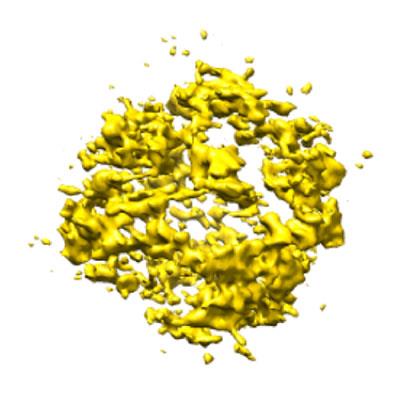
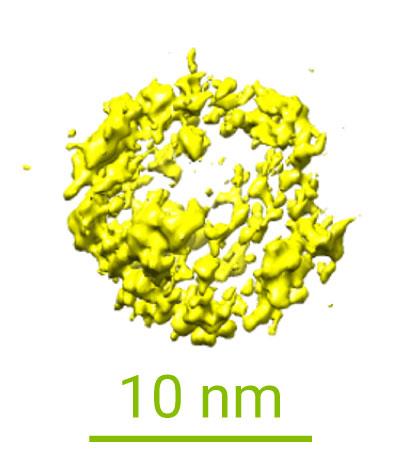
Their second project involves investigating the dynamic behaviour of proteins in liquid. These proteins move by the so-called ‘Brownian motion’. The group wants to understand the structure of the proteins inside their native environment. While the protein is moving in water, they can capture many different profiles in order to reconstruct a 3D image of the protein structure. There is a minimum frame amount needed for the reconstruction, so the time component becomes fundamental in these in-situ studies. The investigation aims to create a library of proteins, like the RCSB PDB, with information on dynamic processes which can complement the information already supplied by the well established cryo-EM technique. Their first results, studying ferritin proteins, were presented at Manchester 2019*.

Schematic representation showing the temporal evolution of the density map reconstruction process of ferritin. A five second long video was segmented into five one second long sub-videos The brownian particle analysis algorithm extracted about 1000 particle profiles from each sub-video, generating five different density maps. The quality and resolution of the refined density maps resulted in being inversely proportional to the sample exposure time to the electron beam.

Proteins play a pivotal role in our physiological conditions and associated diseases. A deeper understanding of the kinetics governing the mechanistic behaviour of proteins in liquid media can lead to big improvements in drug design and ultimately in general healthcare.

*This manuscript is currently being updated with long molecular dynamics simulations of ferritin in solution.

The new Stream system

Now the group is advancing to the DENSsolutions Stream system, allowing them to do new kinds of experiments. The big advantage of the Stream system is that it can control the bulging of the viewing windows and therefore the liquid thickness. Controlling the bulging is essential for creating reproducible results. In previous LPEM in situ systems, the window bulging could differ between experiments, thus preventing experiment reproducibility.

Now with the Stream system, the bulging can be adjusted precisely for each new experiment, guaranteeing the same level of bulging and, therefore, consistent results. Controlling the liquid thickness is also important to achieve high contrast in organic and biological materials. The liquid thickness can be reduced up to the equilibrium where you have the highest possible resolution combined with a thick enough layer to have a realistic sample environment. 

Learn more about our Stream system:

Discover publications in which our Ocean system was used:

Do you want to receive interesting articles like this in your mailbox? Subscribe to our newsletter.

Giant Enhancement in the Supercapacitance of NiFe–Graphene Nanocomposites Induced by a Magnetic Field

Giant Enhancement in the Supercapacitance of NiFe–Graphene Nanocomposites Induced by a Magnetic Field

Underlying nanoparticle behaviour revealed by In Situ TEM heating

Original article by Jorge Romero, Helena Prima-Garcia, Maria Varela, Sara G. Miralles, Víctor Oestreicher,
Gonzalo Abellán and Eugenio Coronado.

The development of supercapacitors holds great promise for future energy storage devices with a high cyclability and durability which can be used in our homes, cars and mobile phones to support the transition to sustainable energy. Even though a lot of effort has been devoted to improving the energy and power densities by optimizing the internal configuration of the capacitor, there is still room for further improvement. Now, researchers have found a way to dramatically improve the capacitance of an FeNi3–graphene hybrid capacitor with about 1100% (from 155 to 1850 F g−1), showing high stability with capacitance retention greater than 90% after 10 000 cycles. They achieved this impressive enhancement by cycling the electrode material in the presence of an applied magnetic field of 4000 G.

Fig. 1. Magnetic graphene–FeNi3 nanocomposite particle under applied magnetic field, pristine sample.

Fig. 2. Magnetic graphene–FeNi3 nanocomposite particle under applied magnetic field, after a 30 min annealing at 400 °C and fast quench back to RT. Arrow pointing out the nanometallic clusters.

In Situ TEM heating

To explain the behaviour of the nanoparticles under the external magnetic-field, Prof. Maria Varela from Universidad Complutense de Madrid, Spain and her colleagues performed in situ heating experiments using a DENSsolutions Lightning D9+ heating and biasing double tilt system. The magnetic field of the microscope objective lens combined with the heating stimuli, provided by the DENSsolutions’ system, were able to observe a significant magnetic field and temperature induced metal segregation of Fe/Ni surfaces forming nanometallic clusters of Ni (<5 nm).

Using these results, the authors were able to explain the dramatic increase of the specific capacitance of the device during the cycling. Furthermore, they opened the door to a systematic improvement of the capacitance values of hybrid supercapacitors, moving the research in this area towards the development of magnetically addressable energy-storage devices.

Learn more about our Lightning system:

Discover more publications made possible by our Lightning system:

Read the original article:

Do you want to receive great articles like this in your mailbox? Subscribe to our newsletter.

Visualizing the dynamic behaviours during carbon nanotube growth in extensive detail

Visualizing the dynamic behaviours during carbon nanotube growth in extensive detail

In situ TEM allows for the direct observation of catalytic processes at relevant pressure and temperature conditions

Original article by Xing Huang, Ramzi Farra, Robert Schlögl and Marc-Georg Willinger

Artist impression showing growth of carbon nanotubes via an iron-catalyzed process. © 2019 DENSsolutions All Rights Reserved

Carbon nanotubes (CNTs) hold many promises, for example in energy storage, high-performance catalysis, photovoltaics, and biomedical devices. Although industrial-scale production of CNTs has been realised, the controllability over the diameter, length, and chirality of CNTs is still unsatisfactory. This is largely due to the lack of atomic information on growth dynamics of CNTs and molecular-level understanding of growth mechanisms. Recently, Huang et al. from FHI Berlin and ETH Zürich have performed an In Situ TEM study on CNT growth and disclosed the growth and termination dynamics of CNTs in atomic detail under relevant conditions. 

The stability of the DENSsolutions Nano-Reactor and the possibility to introduce stimuli, like gas and heating, allowed for the live observation at the atomic-scale:

In Situ TEM video made using the DENSsolutions Climate system, showing Fe-catalyzed multiwalled carbon nanotube growth. Temperature: 800 °C, pressure: 178.65 mbar, diluted H2 + C2H4.

Using In Situ TEM gas and heating, the researchers were able to reveal the influence of pressure and temperature on the growth of CNTs. Previous studies were contradictory about the active state of the catalyst. Now with real-time observations of CNT growth at relevant conditions, researchers were able to reveal not only the active phase of the catalyst but also the rich structural dynamics of the catalyst during the course of CNT growth.

In this study, the Nano-Reactor, the core of the DENSsolutions Climate In Situ TEM system, was used as a carrier for the Fe2O3 sample (precursor material for CNT growth), which was then heated in a diluted hydrogen gas flow as a pre-treatment. The In Situ experiment was started at 150 °C and was followed by a step wise increase up to 800 °C in a gas mixture of H2, C2H4 and He.

To accelerate catalyst research, the DENSsolutions Climate system can be delivered with a dedicated Gas Supply system that enables instant switching between gases and precise control over the gas mixture ratio.

Between 450 °C and 650 °C, the reduction of Fe2O3 to Fe3O4 was accompanied by a collapse of larger particles into smaller ones.

Did you know?

Our Impulse control software comes with a drag & drop profile builder that allows you to design & automate your experiment. It features a wide choice of parameters which enable you to create profiles that suit any sample and application.

WATCH THE VIDEO >

“Thanks to the development of the MEMS-based gas flow Nano-Reactor, we are allowed to perform In Situ experiments inside the chamber of the TEM at relevant conditions. Using the Climate system from DENSsolutions, we have recently carried out a detailed In Situ study on the growth behaviors of CNTs at realistic conditions. On the basis of the real-time observations, we are able to reveal the active structure of the working catalyst and its dynamic re-shaping during the course of CNT growth. Extended observations further reveal three different scenarios for the growth termination of CNTs at the atomic-scale. The presented work provides important insights into understanding the growth and termination mechanisms of CNTs and may serve as an experimental basis for rational design and controlled synthesis of CNTs.”

First and corresponding author – Dr. Xing Huang, ETH Zürich

Learn more about our Climate system and Nano-Reactor:

Discover more publications made possible by our Climate system:

Read the original article:

Do you want to receive great articles like this in your mailbox? Subscribe to our newsletter.

In-situ observation of Ge2Sb2Te5 crystallization at the passivated interface

In-situ observation of Ge2Sb2Te5 crystallization at the passivated interface

New insights on crystalization in PCM materials revealed by in situ TEM

Original article by Kun Ren, Yan Cheng, Mengjiao Xia, Shilong Lv, Zhitang Song. Published in Ceramics International, volume 45, issue 15.

In this work the DENSsolutions in situ TEM Lightning system (8 contact, heating and biasing) has been employed by customers from Hangzhou Dianzi University and East China Normal University, China to study the temperature induced nucleation behavior in Ge2Se2Te5 samples In Situ. This material is used as Phase Change Memory (PCM) and the knowledge of the amorphous-to-crystallize transition and the crystallization behavior is essential to its application, especially in nanometer or sub-nanometer modern and future electronics.

Fig. 1. (a) Temperature profile of the thermal pulse applied on the sample, the maximum temperature is 204 °C. (b)–(j) TEM images of the sample at different stages of the heating pulse, with the timestamp shown in the lower right. The scale bar denotes 100 nm. Crystallization directions are marked by red arrows. 

TEM images of the sample at different stages of the heating pulse, with the timestamp shown in the lower right. The scale bar denotes 100 nm. Crystallization directions are marked by red arrows. 

Using fast thermal pulses of 185 °C – 204 °C applied to a FIB lamella, placed on the MEMS-based Nano-chip it was possible to follow the nucleation dynamics in real time and reveal the heterogeneous nature of the nucleation, e.g. crystallization at the interface and the interior of the sample. This distinguished behavior of Ge2Se2Te5 is caused by in-situ deposition of the sample thus avoiding the formation of the covalent bonds between the PCM material and the substrate. Formation of a passivation layer at the PCM-substrate interface can lead to an enhancement of the switching speed in memory with decreasing the cell size.

Learn more about FIB lamella sample preparation:

Learn more about our Lightning system:

Converting CO2 into a valuable energy carrier using a model In2O3 catalyst

Converting CO2 into a valuable energy carrier using a model In2O3 catalyst

New discoveries made possible by In Situ TEM gas and heating

Original article by Athanasia Tsoukalou, Paula M. Abdala, Dragos Stoian, Xing Huang, Marc-Georg Willinger, Alexey Fedorov and Christoph R. Müller. Published in the Journal of the American Chemical Society on 19 July 2019.

Artist impression of methanol synthesis via CO2 hydrogenation using In2O3 catalyst (copyright of the American Chemical Society)

The direct hydrogenation of CO2 to methanol shows promise to be an important technique to reduce the amount of greenhouse gases in the atmosphere and thereby mitigate the negative effects of climate change while producing an important energy carrier. In his contribution to this article, Dr. Xing Huang has used In Situ TEM techniques to assess the limits of In2O3 catalytic performance in CO2 hydrogenation.

In Situ TEM Climate Nano-Reactor study

This catalyst research article by ETH Zürich provides a good demonstration on how in situ TEM experiments can add value to the study of reaction mechanisms. First, the structural changes in the catalyst material were studied with traditional TEM techniques before and after the CO2 reduction. By using the Climate in situ TEM system, the researchers were able to see the dynamics of the reaction, even at much lower pressures (0.8 vs. 20 Bar) than in the original operando experiment.

In Situ TEM video made using the DENSsolutions Climate system, at 300 °C, showing the co-existence of crystalline and amorphous phases as well as the transformation into film structures of the In2O3 catalyst.

Amorphization of the catalyst material inside the Nano-Reactor takes places in a few minutes, compared to hours in the capillary reactor. Re-activation of the catalyst is made easy by the Climate Gas Supply System since the hydrogen plus carbon-dioxide gas flow can be replaced by an oxygen flow at any moment.

“Direct observation using in situ TEM clearly reveals that the structure of In2O3 nanoparticles is highly dynamic under reaction conditions and irradiation of electron beam. The In2O3 is observed to transform into a dynamic structure in which both crystalline and amorphous phases coexist and continuously inter-convert.

This observation is in line with the operando XAS-XRD study revealing formation of the amorphous In0/In2O3 phase with time on stream. To sum up, combination of in situ TEM with other in situ/operando techniques enables to build a direct relationship between the structure and the catalytic performance of the In2O3 catalyst in CO2 hydrogenation to methanol.”

Co-author – Dr. Xing Huang, ETH Zürich

Learn more about our Climate system and Nano-Reactor:

Discover more publications made possible by our Climate system:

Real‐Time Imaging of Nanoscale Redox Reactions over Bimetallic Nanoparticles

Real‐Time Imaging of Nanoscale Redox Reactions over Bimetallic Nanoparticles

Shu Fen Tan, See Wee Chee, Zhaslan Baraissov, Hongmei Jin, Teck Leong Tan, Utkur Mirsaidov
Published in Advanced Functional Materials on 16 July 2019

Publication

Video 1: In situ TEM movie of a Pt–Ni rhombic dodecahedron NP undergoing oxidation reaction in 20% O2 / 80% N2 gaseous environment at 400 °C inside a gas cell.
Video 2: In situ TEM movie of a Pt–Ni rhombic dodecahedron NP undergoing reduction reaction in 5% H2 / 95% N2 gaseous environment at 400 °C inside a gas cell.

This recent article from National University of Singapore about the catalyst activity of bimetallic nanoparticles clearly demonstrates the versatility of the Climate G+ gas & heating system that was used for the in situ TEM experiments.

Figure S4. In situ TEM images showing the evolution of Pt–Ni NPs (A) before and (B) after the oxidation (20% O2 / 80% N2) reaction followed by (C) the reduction (5% H2 / 95% N2) reaction at 400 °C inside a gas cell. Here, t = 0 s marks the start of 20% O2 / 80% N2 flow. At t = 133.1 s, the gas mixture was switched to 5% H2 / 95% N2.

Fast switching between oxidizing and reducing gas conditions allows direct observation of the morphological changes in the catalyst material. The video’s above also demonstrate the UHR image stability at in situ conditions.

Combining the images and video’s from this experiment with SAED, EDS and Mass Spectroscopy results gives valuable information about the areas where the catalyst is most active.