Gas Analyzer supporting ex situ Catalyst experiments

Gas Analyzer supporting ex situ Catalyst experiments

Technical Research Engineer Marien Bremmer MSc with the gas analyzer (blue) in the background
Our solutions not only allow for highly controllable in situ experiments, they also allow for ex situ experiments that might save you valuable in situ time. With this ex situ experiment, we were able to prove the performance of the catalyst before moving in to the TEM.

The experiment

We used palladium nanoparticles for our catalyst These particles were dropcasted inside a Climate MEMS based Nano-Reactor. For the gas supply we used the Climate G+ system which allows for up to 3 gases to be mixed. We loaded the system with oxygen and methane as reactive gases and measured carbon monoxide and carbon dioxide as reaction products.

Figure 1. Sample temperature (top) and gas partial pressure (middle & bottom) measured as a function of time.

Catalyst performance

First we used the gas analyzer combined with our accurate temperature control to measure the catalyst performance. The supply of reactants was kept at a constant level (figure 1 – middle graph) while we used our Impulse software to automatically ramp up the temperature of the Nano-Reactor from 300 to 700 °C in 60 seconds (figure 1 – top graph). As a result we measured the level of reactant gases dropping and the level of reaction products rising (figure 1 – bottom graph). We see the levels stabilizing when the temperature is constant.


High activity phase shifting

Figure 2. Gas mixture composition into the Nano-Reactor (top), partial pressures of gases flowing out of the Nano-Reactor (middle) and dissipated power by the Nano-Reactor heater (bottom) as a function of time.
During the next experiment, we kept the palladium sample at a constant temperature while increasing the concentration of methane (CH4) from 5% to 10% (figure 2 – top graph). At around  t = 300 seconds you can clearly see fluctuations in the level of reaction products (figure 2 – middle graph). Here we observe the catalyst shifting in and out of a high activity phase that is reached at elevated temperatures. When passing a certain temperature range, this high activity phase can be demonstrated by oscillations in the partial pressure of the gas reaction products. Also oscillations in the power dissipated by the heater (figure 2 – bottom graph) indicates a change of activity at the sample.
At t = 500 seconds we use our Impulse software to drop the level of methane in steps of 0,5%. Measuring the COlevel with our gas analyzer we can clearly see the influence of the first drop in concentration. The COproduction rate starts to more unstable. By dropping the concentration with another 0,5%, the frequency of the fluctuations increases and, after the third drop of concentration, the catalyst starts to shift back to its normal activity phase, stabilizing the COproduction after the fourth drop.
 

High time resolution

Figure 3. Detailed results for partial pressure (top) and power dissipation (bottom) measurements.

We zoomed in at areas A and B and plotted the results from the gas analyzer as well as those from the power dissipated by our 4-point probe temperature control system (see figure 3). This allows us to correlate the two measurements. We see that the reaction gases are in counter phase of each other and that their extremes are in line with the tops of the measured power. This shows not only a very high stability in temperature control but also a very high time resolution.

Conclusions

Thanks to our high accuracy gas analyzer and heating control and measurement, you are able to do ex situ experiments that can give you valuable data. This data can lead to new discoveries or can be used to prepare your in situ experiment better.

Marien Bremmer who conducted the experiment commented:
“Using the Climate G+ in combination with the Gas Analyzer allows you to characterize your catalyst sample ex situ, finding the best gas and temperature conditions for your reaction, and with this data to go to the TEM to finalize your research with real in situ images and spectroscopy.”

Download the
Gas Analyzer Application Note

Technical Research Engineer Marien Bremmer MSc with the gas analyzer (blue) in the background
Our solutions not only allow for highly controllable in situ experiments, they also allow for ex situ experiments that might save you valuable in situ time. With this ex situ experiment, we were able to prove the performance of the catalyst before moving in to the TEM.

The experiment

We used palladium nanoparticles for our catalyst These particles were dropcasted inside a Climate MEMS based Nano-Reactor. For the gas supply we used the Climate G+ system which allows for up to 3 gases to be mixed. We loaded the system with oxygen and methane as reactive gases and measured carbon monoxide and carbon dioxide as reaction products.

Figure 1. Sample temperature (top) and gas partial pressure (middle & bottom) measured as a function of time.

Catalyst performance

First we used the gas analyzer combined with our accurate temperature control to measure the catalyst performance. The supply of reactants was kept at a constant level (figure 1 – middle graph) while we used our Impulse software to automatically ramp up the temperature of the Nano-Reactor from 300 to 700 °C in 60 seconds (figure 1 – top graph). As a result we measured the level of reactant gases dropping and the level of reaction products rising (figure 1 – bottom graph). We see the levels stabilizing when the temperature is constant.
 

High activity phase shifting

Figure 2. Gas mixture composition into the Nano-Reactor (top), partial pressures of gases flowing out of the Nano-Reactor (middle) and dissipated power by the Nano-Reactor heater (bottom) as a function of time.
During the next experiment, we kept the palladium sample at a constant temperature while increasing the concentration of methane (CH4) from 5% to 10% (figure 2 – top graph). At around  t = 300 seconds you can clearly see fluctuations in the level of reaction products (figure 2 – middle graph). Here we observe the catalyst shifting in and out of a high activity phase that is reached at elevated temperatures. When passing a certain temperature range, this high activity phase can be demonstrated by oscillations in the partial pressure of the gas reaction products. Also oscillations in the power dissipated by the heater (figure 2 – bottom graph) indicates a change of activity at the sample.
At t = 500 seconds we use our Impulse software to drop the level of methane in steps of 0,5%. Measuring the COlevel with our gas analyzer we can clearly see the influence of the first drop in concentration. The COproduction rate starts to more unstable. By dropping the concentration with another 0,5%, the frequency of the fluctuations increases and, after the third drop of concentration, the catalyst starts to shift back to its normal activity phase, stabilizing the COproduction after the fourth drop.
 

High time resolution

Figure 3. Detailed results for partial pressure (top) and power dissipation (bottom) measurements.

We zoomed in at areas A and B and plotted the results from the gas analyzer as well as those from the power dissipated by our 4-point probe temperature control system (see figure 3). This allows us to correlate the two measurements. We see that the reaction gases are in counter phase of each other and that their extremes are in line with the tops of the measured power. This shows not only a very high stability in temperature control but also a very high time resolution.

Conclusions

Thanks to our high accuracy gas analyzer and heating control and measurement, you are able to do ex situ experiments that can give you valuable data. This data can lead to new discoveries or can be used to prepare your in situ experiment better.

Marien Bremmer who conducted the experiment commented:
“Using the Climate G+ in combination with the Gas Analyzer allows you to characterize your catalyst sample ex situ, finding the best gas and temperature conditions for your reaction, and with this data to go to the TEM to finalize your research with real in situ images and spectroscopy.”

Download the
Gas Analyzer Application Note

1st European Climate User Meeting

1st European Climate User Meeting

Where we find out how our solutions accelerate research and how we can adapt to new challenges.

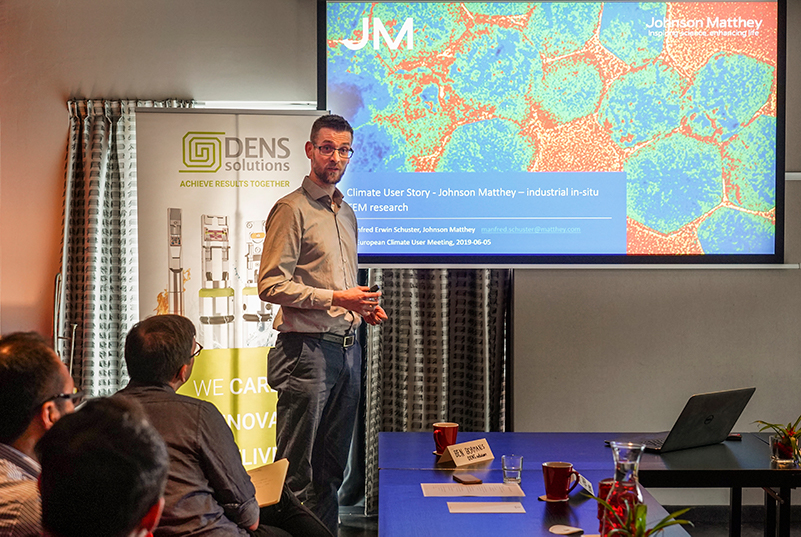
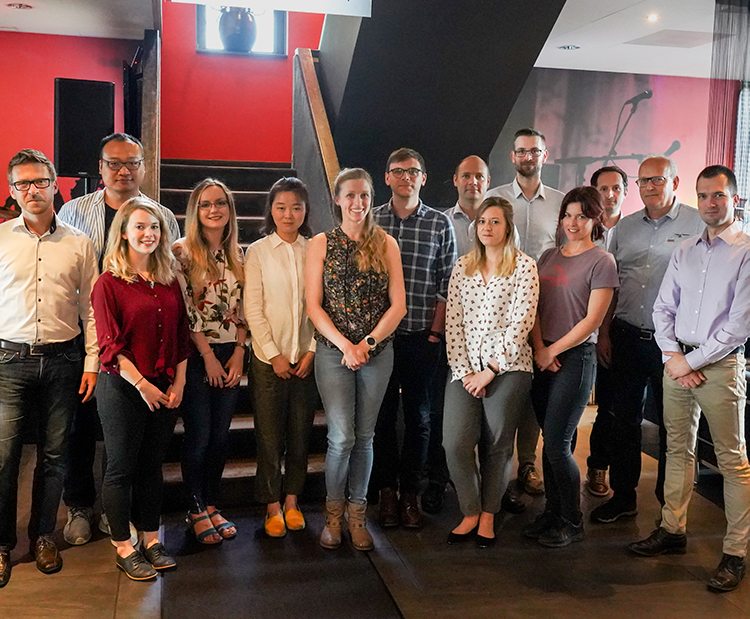
DENSsolutions team members together with customers from FHI Berlin, DTU Nanolab Kgs. Lyngby, ER-C Jülich, EMAT Antwerp, ETH Zürich, Johnson-Matthey Didcot, University of Limerick, Trinity College Dublin and Queen’s University Belfast.
A little over 3 years ago, the first Climate in situ gas & heating systems were installed by DENSsolutions at customer sites. Therefore, the time has come to evaluate the results obtained so far by all our European customers and to share experiences. A 2-day meeting was held in Delft, the Netherlands on 5th & 6th June 2019 to provide an open forum for both users and the DENSsolutions team to share their results and suggestions.
Dr. Michele Conroy and Dr. Jennifer Cookman from the University of Limerick sharing their future plans for Climate experiments.

Presentations and discussions

Each Climate user gave a presentation on: their in situ gas & heating research, other research using the Climate system in their departments, and plans for future research.The topics covered included catalyst research on nano-particles, carbon nano-tube growth, and materials science on lamella-type samples. Our team members also gave presentations on our latest product development and newest applications.

Dr. Armand Beche (center) from EMAT Antwerp
Dr. Xing Huang (right) from ETH Zurich
We value the experience and feedback that our users from different institutes and companies, as well as DENSsolutions team members, brought to the discussions. Our discussions were dynamic and covered not only in situ TEM but also experiments that used the Climate Nano-Reactor in other environments such as a Beamline or an X-ray microscope.
Dr. Manfred Schuster from Johnson Matthey sharing insights from their customized beamline experiment
During the conference, new ideas, theories and product feedback were shared so we left with a list of possible improvements for our solutions as needed by the people who use them. These included: ease-of-use items, improvements on MEMS chips, tools to improve sample drop casting, and ideas on how to improve gas & heating control.
Dr. Thomas Hansen DTU explaining on the importance of low dose imaging.

Continuing the conversation

All the participants agreed that we should continue these discussions to improve both in situ TEM research and the tools that facilitate it. DENSsolutions will enable these conversations as part of an online environment as well as by organizing new Climate user meetings. Furthermore we see possibilities to organize forums like this in the future for other products and for users from other regions.

Ronald Marx MSc, DENSsolutions
Our Climate Product Manager Ronald Marx commented at the end of the 2-day meeting:
“It was a great pleasure for me to host all these Climate users in Delft and engage in discussions that reveal both the current and the potential new benefits of doing in situ research with the system’.

Download the Climate Brochure

For more information on features and specifications.

<!--[if lte IE 8]><!-- [et_pb_line_break_holder] --><script charset="utf-8" type="text/javascript" src="//js.hsforms.net/forms/v2-legacy.js"></script><!-- [et_pb_line_break_holder] --><![endif]--><!-- [et_pb_line_break_holder] --><script charset="utf-8" type="text/javascript" src="//js.hsforms.net/forms/v2.js"></script><!-- [et_pb_line_break_holder] --><script><!-- [et_pb_line_break_holder] --> hbspt.forms.create({<!-- [et_pb_line_break_holder] --> portalId: "469089",<!-- [et_pb_line_break_holder] --> formId: "0d52a62f-f229-49fb-a2d3-9b8c66a5a526", submitButtonClass: 'et_pb_button'<!-- [et_pb_line_break_holder] -->});<!-- [et_pb_line_break_holder] --></script>

Where we find out how our solutions accelerate research and how we can adapt to new challenges.

DENSsolutions team members together with customers from FHI Berlin, DTU Nanolab Kgs. Lyngby, ER-C Jülich, EMAT Antwerp, ETH Zürich, Johnson-Matthey Didcot, University of Limerick, Trinity College Dublin and Queen’s University Belfast.
A little over 3 years ago, the first Climate in situ gas & heating systems were installed by DENSsolutions at customer sites. Therefore, the time has come to evaluate the results obtained so far by all our European customers and to share experiences. A 2-day meeting was held in Delft, the Netherlands on 5th & 6th June 2019 to provide an open forum for both users and the DENSsolutions team to share their results and suggestions.
Dr. Michele Conroy and Dr. Jennifer Cookman from the University of Limerick sharing their future plans for Climate experiments.

Presentations and discussions

Each Climate user gave a presentation on: their in situ gas & heating research, other research using the Climate system in their departments, and plans for future research.The topics covered included catalyst research on nano-particles, carbon nano-tube growth, and materials science on lamella-type samples. Our team members also gave presentations on our latest product development and newest applications.

Dr. Armand Beche (center) from EMAT Antwerp
Dr. Xing Huang (right) from ETH Zurich
We value the experience and feedback that our users from different institutes and companies, as well as DENSsolutions team members, brought to the discussions. Our discussions were dynamic and covered not only in situ TEM but also experiments that used the Climate Nano-Reactor in other environments such as a Beamline or an X-ray microscope.
Dr. Manfred Schuster from Johnson Matthey sharing insights from their customized beamline experiment
During the conference, new ideas, theories and product feedback were shared so we left with a list of possible improvements for our solutions as needed by the people who use them. These included: ease-of-use items, improvements on MEMS chips, tools to improve sample drop casting, and ideas on how to improve gas & heating control.
Dr. Thomas Hansen DTU explaining on the importance of low dose imaging.

Continuing the conversation

All the participants agreed that we should continue these discussions to improve both in situ TEM research and the tools that facilitate it. DENSsolutions will enable these conversations as part of an online environment as well as by organizing new Climate user meetings. Furthermore we see possibilities to organize forums like this in the future for other products and for users from other regions.

Ronald Marx MSc, DENSsolutions
Our Climate Product Manager Ronald Marx commented at the end of the 2-day meeting:
“It was a great pleasure for me to host all these Climate users in Delft and engage in discussions that reveal both the current and the potential new benefits of doing in situ research with the system’.

Interested in the Climate system?

Download the Climate Brochure

For more information on features and specifications.

<!--[if lte IE 8]><!-- [et_pb_line_break_holder] --><script charset="utf-8" type="text/javascript" src="//js.hsforms.net/forms/v2-legacy.js"></script><!-- [et_pb_line_break_holder] --><![endif]--><!-- [et_pb_line_break_holder] --><script charset="utf-8" type="text/javascript" src="//js.hsforms.net/forms/v2.js"></script><!-- [et_pb_line_break_holder] --><script><!-- [et_pb_line_break_holder] --> hbspt.forms.create({<!-- [et_pb_line_break_holder] --> portalId: "469089",<!-- [et_pb_line_break_holder] --> formId: "0d52a62f-f229-49fb-a2d3-9b8c66a5a526", submitButtonClass: 'et_pb_button'<!-- [et_pb_line_break_holder] -->});<!-- [et_pb_line_break_holder] --></script>

UConn Opening a New Center for In Situ & Operando TEM in Collaboration With DENSsolutions

UConn Opening a New Center for In Situ & Operando TEM in Collaboration With DENSsolutions

UConn Tech Park (Magda Biernat)

At DENSsolutions, we believe that together we can achieve more. So, we are proud to announce our partnership with the University of Connecticut (UConn).

A new center commemorating this exciting collaboration will be opened. The UConn DENSsolutions Center for IN-siTu/Operando Electron Microscopy (InToEM) will be the home of scientists and engineers with complementary expertise working at the frontier of understanding materials dynamics. The InToEM center is situated in UConn Tech Park, the University of Connecticut’s premier center for cutting-edge research, industry collaboration, and innovation.

Our contribution

The DENSsolutions Climate MEMS-based Nano-Reactor TEM system will be at the heart of this research center. The system has a unique capacity to probe high-temperature gas-solid reactions with high spatial resolution under ambient pressure, in gaseous environment controlled by sophisticated dynamic gas mixing. Dynamic changes in local site-specific structural information of nanomaterials can be monitored in real-time under realistic reaction conditions.

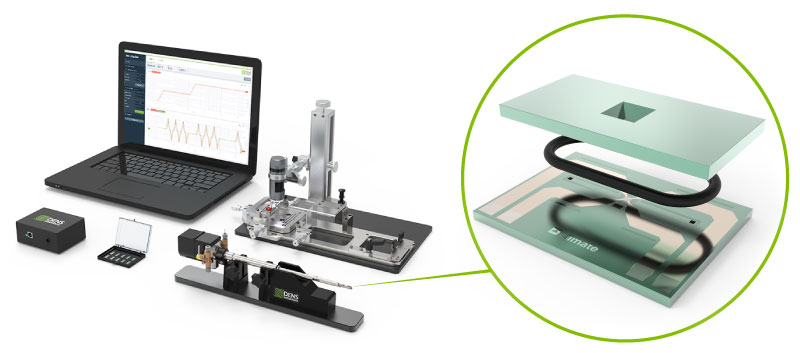
Climate In Situ Gas & heating system with featured MEMS-based Nano-Reactor (gas supply not on the picture)
Climate In Situ Gas & heating system (gas supply not on the picture)
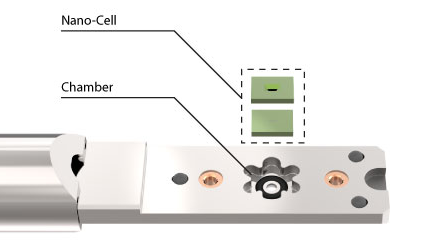
MEMS-based Nano-Reactor

New Opportunities

As the demands of research need more complex solutions, we want to move towards Operando environmental electron microscopy. Our solutions will allow concurrent mass-spectrometry, calorimetry and chemical analysis during reactions.
These new capabilities will provide unprecedented insight into the correlation between materials dynamics and temporal performance at the fundamental atomic-scale, and will open up a world of research opportunities in heterogeneous catalysis, fuel cells, corrosion, and materials growth and transformation.

Dr. Zhu with the Climate system (UConn Photo)
Yuanyuan Zhu, the Director of the InToEM, Assistant Professor in the Department of Materials Science and Engineering, Institute of Materials Science, UConn commented:
“Being able to study the behavior of materials in their native environment has been microscopist’s dream since the birth of TEM. I’m very excited about the InToEM center, which will provide an optimal scientific “sandbox” to explore microscopy as it should be.”
Ben Bormans, CEO of DENSsolutions, is very pleased to have UConn and the InToEM center led by Dr. Zhu, as a customer:
“DENSsolutions’ vision is that in situ and operando TEM can contribute to solving societal challenges like climate change and green/clean technologies.
These new techniques connect microscopy more meaningfully with chemistry, materials research and nanotechnology. Therefore, here at DENSsolutions, we all are very, very excited about being a partner in the InToEM center.
Here, a lot of good things come together: the Materials Science and Engineering Department and Institute of Materials Science of UConn with world-class performance in Materials research, the fantastic facilities of the Business Innovation Center, and the focus and passion of the scientists of INToEM.”

Download the Climate Brochure

For more information on features and specifications.

<!--[if lte IE 8]><!-- [et_pb_line_break_holder] --><script charset="utf-8" type="text/javascript" src="//js.hsforms.net/forms/v2-legacy.js"></script><!-- [et_pb_line_break_holder] --><![endif]--><!-- [et_pb_line_break_holder] --><script charset="utf-8" type="text/javascript" src="//js.hsforms.net/forms/v2.js"></script><!-- [et_pb_line_break_holder] --><script><!-- [et_pb_line_break_holder] --> hbspt.forms.create({<!-- [et_pb_line_break_holder] --> portalId: "469089",<!-- [et_pb_line_break_holder] --> formId: "0d52a62f-f229-49fb-a2d3-9b8c66a5a526", submitButtonClass: 'et_pb_button'<!-- [et_pb_line_break_holder] -->});<!-- [et_pb_line_break_holder] --></script>
UConn Tech Park (Magda Biernat)

At DENSsolutions, we believe that together we can achieve more. So, we are proud to announce our partnership with the University of Connecticut (UConn).

A new center commemorating this exciting collaboration will be opened. The UConn DENSsolutions Center for IN-siTu/Operando Electron Microscopy (InToEM) will be the home of scientists and engineers with complementary expertise working at the frontier of understanding materials dynamics. The InToEM center is situated in UConn Tech Park, the University of Connecticut’s premier center for cutting-edge research, industry collaboration, and innovation.

Our contribution

The DENSsolutions Climate MEMS-based Nano-Reactor TEM system will be at the heart of this research center. The system has a unique capacity to probe high-temperature gas-solid reactions with high spatial resolution under ambient pressure, in gaseous environment controlled by sophisticated dynamic gas mixing. Dynamic changes in local site-specific structural information of nanomaterials can be monitored in real-time under realistic reaction conditions.

Climate In Situ Gas & heating system with featured MEMS-based Nano-Reactor (gas supply not on the picture)
Climate In Situ Gas & heating system (gas supply not on the picture)
MEMS-based Nano-Reactor

New Opportunities

As the demands of research need more complex solutions, we want to move towards Operando environmental electron microscopy. Our solutions will allow concurrent mass-spectrometry, calorimetry and chemical analysis during reactions.
These new capabilities will provide unprecedented insight into the correlation between materials dynamics and temporal performance at the fundamental atomic-scale, and will open up a world of research opportunities in heterogeneous catalysis, fuel cells, corrosion, and materials growth and transformation.

Dr. Zhu with the Climate system (UConn Photo)
Yuanyuan Zhu, the Director of the InToEM, Assistant Professor in the Department of Materials Science and Engineering, Institute of Materials Science, UConn commented:
“Being able to study the behavior of materials in their native environment has been microscopist’s dream since the birth of TEM. I’m very excited about the InToEM center, which will provide an optimal scientific “sandbox” to explore microscopy as it should be.”
Ben Bormans, CEO of DENSsolutions, is very pleased to have UConn and the InToEM center led by Dr. Zhu, as a customer:
“DENSsolutions’ Vision is that in situ and operando TEM can contribute to solving societal challenges like climate change and green/clean technologies.
These new techniques connect microscopy more meaningfully with chemistry, materials research and nanotechnology. Therefore, here at DENSsolutions, we all are very, very excited about being a partner in the InToEM center.
Here, a lot of good things come together: the Materials Science and Engineering Department and Institute of Materials Science of UConn with world-class performance in Materials research, the fantastic facilities of the Business Innovation Center, and the focus and passion of the scientists of INToEM.”

Download the Climate Brochure

For more information on features and specifications.

<!--[if lte IE 8]><!-- [et_pb_line_break_holder] --><script charset="utf-8" type="text/javascript" src="//js.hsforms.net/forms/v2-legacy.js"></script><!-- [et_pb_line_break_holder] --><![endif]--><!-- [et_pb_line_break_holder] --><script charset="utf-8" type="text/javascript" src="//js.hsforms.net/forms/v2.js"></script><!-- [et_pb_line_break_holder] --><script><!-- [et_pb_line_break_holder] --> hbspt.forms.create({<!-- [et_pb_line_break_holder] --> portalId: "469089",<!-- [et_pb_line_break_holder] --> formId: "0d52a62f-f229-49fb-a2d3-9b8c66a5a526", submitButtonClass: 'et_pb_button'<!-- [et_pb_line_break_holder] -->});<!-- [et_pb_line_break_holder] --></script>

Membranes made from Nano-droplets have potential in Medical Research

Membranes made from Nano-droplets have potential in Medical Research

Membranes formed in-lab from nano-droplets could have future use in medicines

For the first time, researchers from the Laboratory of Materials and Interface Chemistry, Eindhoven University of Technology (TUE), with a significant contribution of assistant professor Joe Patterson, have made a comprehensive video of liquid membrane formation using a transmission electron microscope (TEM). They used soap-like nanodroplets submerged in water to create the membrane. Their results are published in Nature, Chemistry and have been highlighted in the Nature, Chemistry News & Views article ‘The molecular Lego movie’.

LPEM Movie of the in-situ self-assembly experiment. Stabilized and cropped. Ianiro, A. et al. Nat. Chem. (2019)

This experiment has continuously recorded the whole process of how the membrane is formed under a microscope. Before this, scientists had to freeze the final membrane and get a snapshot of one or several moments of the membrane forming. This advance is achieved due to a well controlled liquid environment and can be now set in the microscope thanks to the DENSsolutions Ocean system.

Screenshots from the video of the membrane forming on the silicon chip. These were taken using a transmission electron microscope. You can watch the full video here. Ianiro, A. et al. Nat. Chem. (2019)
Membranes are of great interest in research as their selective barriers have potential uses in many fields: drug delivery, water treatment and chemical processes all rely on membrane technology. They are of particular interest in pharmaceutical research as they are the ideal shape to transport a drug through the body and release it only when the membrane finds a specific type of cell, for example, a cancer cell.

The Experiment

The researchers from the Materials and Interface Chemistry group led by Prof. Nico Sommerdijk formed a membrane from soap-like molecules called amphiphilic molecules, which simply means that they interact with both fats and water. Amphiphilic molecules are good building blocks for membranes as they can be lined up with the water-interacting side facing one way and the lipid-interacting parts facing the other way to form larger structures.

The DENSsolutions Ocean In Situ TEM liquid system was essential in this research. The core of the system consists of a dual chip Nano-Cell that sandwiches two chips together to form a microfluidic compartment.

First, the chambers within the tip surrounding the Nano-Cell were flooded with an amphiphilic solvent in order for it to fill the compartment. Then, the solvent was expelled with air, leaving the compartment saturated. Finally, the tip was flooded with water which gradually diffused into the compartment. It was during this stage that the water particles encouraged the solvent particles to organise themselves into a membrane structure.

Step 1. Polymer solvent

Step 2. Air

Step 3. Water

The membrane itself formed in stages. First, the solvent molecules arranged themselves into nanodroplets with a hydrophobic core and a protective hydrophilic shell. The DENSsolutions Nano-Cell created a hotspot of these nanodroplets and they gradually arranged themselves into a hollow membrane.
Diagram of the amphiphilic membrane forming in water. Arash Nikoubashman and Friederike Schmid.

Future Research

Watching how the nanoparticles form and arrange themselves with an electron microscope is a huge step in learning how to manipulate these membranes. The techniques covered in this research will be of interest to scientists working in food science, synthesis chemistry and separation science.

Hanglong Wu, who made a significant contribution to this paper during his PhD period, commented in an interview with DENSsolutions, that the technique “has been extensively used in studying the dynamics and structures of hard materials (for example, metallic nanoparticles) in the aqueous solution in the last decade, but it has been barely employed into soft matter field, mainly due to the inherent high beam sensitivity and low contrast.

“In this Nat. Chem. paper, we actually demonstrate we can probe the soft matter formation with such high contrast. People for sure will start to use the technique in the soft matter field.” – Hanglong Wu

The next stage will be fine-tuning how to manipulate the size and shape of the membrane. This research from Eindhoven is an important step in an exciting field.

If you are interested in the equipment we provided for this research, then contact us to see how we can streamline your experiments.

Membranes formed in-lab from nano-droplets could have future use in medicines

For the first time, researchers from the Laboratory of Materials and Interface Chemistry, Eindhoven University of Technology (TUE), with a significant contribution of assistant professor Joe Patterson, have made a comprehensive video of liquid membrane formation using a transmission electron microscope (TEM). They used soap-like nanodroplets submerged in water to create the membrane. Their results are published in Nature, Chemistry and have been highlighted in the Nature, Chemistry News & Views article ‘The molecular Lego movie’.

LPEM Movie of the in-situ self-assembly experiment. Stabilized and cropped. Ianiro, A. et al. Nat. Chem. (2019)

This experiment has continuously recorded the whole process of how the membrane is formed under a microscope. Before this, scientists had to freeze the final membrane and get a snapshot of one or several moments of the membrane forming. This advance is achieved due to a well controlled liquid environment and can be now set in the microscope thanks to the DENSsolutions Ocean system.

Screenshots from the video of the membrane forming on the silicon chip. These were taken using a transmission electron microscope. You can watch the full video here. Ianiro, A. et al. Nat. Chem. (2019)
Membranes are of great interest in research as their selective barriers have potential uses in many fields: drug delivery, water treatment and chemical processes all rely on membrane technology. They are of particular interest in pharmaceutical research as they are the ideal shape to transport a drug through the body and release it only when the membrane finds a specific type of cell, for example, a cancer cell.

The Experiment

The researchers from the Materials and Interface Chemistry group led by Prof. Nico Sommerdijk formed a membrane from soap-like molecules called amphiphilic molecules, which simply means that they interact with both fats and water. Amphiphilic molecules are good building blocks for membranes as they can be lined up with the water-interacting side facing one way and the lipid-interacting parts facing the other way to form larger structures.

The DENSsolutions Ocean In Situ TEM liquid system was essential in this research. The core of the system consists of a dual chip Nano-Cell that sandwiches two chips together to form a microfluidic compartment.

First, the chambers within the tip surrounding the Nano-Cell were flooded with an amphiphilic solvent in order for it to fill the compartment. The solvent was then expelled with air, leaving the compartment saturated. Then, the solvent was expelled with air, leaving the compartment saturated. Finally, the tip was flooded with water which gradually diffused into the compartment. It was during this stage that the water particles encouraged the solvent particles to organise themselves into a membrane structure.

Step 1. Polymer solvent

Step 2. Air

Step 3. Water

The membrane itself formed in stages. First, the solvent molecules arranged themselves into nanodroplets with a hydrophobic core and a protective hydrophilic shell. The DENSsolutions Nano-Cell created a hotspot of these nanodroplets and they gradually arranged themselves into a hollow membrane.
Diagram of the amphiphilic membrane forming in water. Arash Nikoubashman and Friederike Schmid.

Future Research

Watching how the nanoparticles form and arrange themselves with an electron microscope is a huge step in learning how to manipulate these membranes. The techniques covered in this research will be of interest to scientists working in food science, synthesis chemistry and separation science.

Hanglong Wu, who made a significant contribution to this paper during his PhD period, commented in an interview with DENSsolutions, that the technique “has been extensively used in studying the dynamics and structures of hard materials (for example, metallic nanoparticles) in the aqueous solution in the last decade, but it has been barely employed into soft matter field, mainly due to the inherent high beam sensitivity and low contrast.

“In this Nat. Chem. paper, we actually demonstrate we can probe the soft matter formation with such high contrast. People for sure will start to use the technique in the soft matter field.” – Hanglong Wu

The next stage will be fine-tuning how to manipulate the size and shape of the membrane. This research from Eindhoven is an important step in an exciting field.

If you are interested in the equipment we provided for this research, then contact us to see how we can streamline your experiments.

Calcination Leads to Atomic Dispersion: New Climate publication in Nature Communications

Calcination Leads to Atomic Dispersion: New Climate publication in Nature Communications

Substrate-supported noble metal single-atom catalysts (SACs) are widely used in many important chemical reactions for their high activity and selectivity. However, the fabrication of high concentration of single-atom catalysts (SACs) with long-term stability remains a challenge. For example, at the working conditions, usually calcination at a high temperature, the supported SACs migrate and coarsen (a process named Ostwald ripening), resulting in a decreased catalytic performance.
Writing in Nature Communications, researchers from Dalian Institute of Chemical Physics (Chinese Academy of Sciences) and Tianjin University of Technology, found that the high- temperature calcination of Pt nanoparticles on reductive Fe2Osubstrate in air is favorable for the formation of high concentrations of thermally stable Pt SACs, which is different from the traditional Ostwald ripening. By employing the Climate in situ gas & heating solution and HAADF-STEM imaging, they directly observed the disintegration of Pt nanoparticles at 800 °C under a flow of 1 bar O2 .
During the in- situ reaction process, they found particle disappearance occurs in the absence coalescence, implying the genesis of atomically-dispersed Pt entities. The in-situ results are in good agreement with the ex-situ characterizations and theoretical calculations. The new findings provide a new route to fabricate high-metal-loading and thermal stable SACs for a wide range of industrially important catalytic reactions.

Imaging Ferritin in Water

Prof. Giuseppe Battaglia and his group at University College in London have performed high resolution imaging of Ferritin proteins in liquid using a DENSsolutions Ocean In situ liquid system and a Gatan K2-IS. We are looking at objects as small as 10 nm imaged at a resolution close to 1 nm. These preliminary results highlight once more the importance of Liquid Phase Electron Microscopy (LP EM) and the need for a stable and reliable liquid cell solution