Operando TEM using Climate G+ to study Metal catalyst behavior during reaction

Operando TEM using Climate G+ to study Metal catalyst behavior during reaction

Original article by See Wee Chee, Juan Manuel Arce-Ramos, Wenqing Li, Alexander Genest & Utkur Mirsaidov. Published in Nature Communications volume 11, Article number: 2133 (2020) .

The catalytic performance of noble metal nanoparticles (NPs) is decided by their surface structure. Hence, understanding the structural dynamics of nanoparticles during catalysis is necessary for the design of improved catalysts that can lead to significant reductions in energy consumption for industrial catalytic processes. Using the DENSsolutions Climate system, scientists from National University of Singapore (NUS) showed that they were able to capture structural changes in Palladium (Pd) NPs during CO oxidation under realistic operating environments and correlate those changes with the NPs’ catalytic activity.

The Pd NPs showed an inactive faceted structure at low temperatures which changed to an active more rounded structure at higher temperatures. This change in NP structure and activity reverses when the temperature is reduced. The reversibility of NP structural transformations has important implications for our understanding of active catalyst structures and reinforces the need for direct operando observations.

This movie was recorded during a temperature ramp from 300 to 500 °C at a rate of 2 °C/s. It clearly shows the change in the NP shape, where the flat facets and sharp corners became more rounded, which occurred concurrently with the change in catalytic activity.

Climate system

For this research, the Climate G+ system was used in combination with the DENSsolutions Gas Analyzer. The system enabled the researchers to attribute the changes in catalytic activity to the observed structural changes, which was further confirmed by thermodynamic calculations. Matching the high-resolution image sequences with outlet gas composition changes helped the authors to understand how the NP structure can influence the availability of active sites on a NP’s surface.

This research exemplifies how the different data streams from the Climate G+ (calorimetry), the Gas Analyzer (partial pressure) and the TEM detector (HR-TEM image) can be correlated into meaningful results: 

TEM detector

HR-TEM images show that the shape of the Pd NP’s in the Nano-Reactor changes from clearly faceted at 400°C to a more rounded shape at 600°C. The Pd NP’s become faceted again after the temperature was dropped to 400°C. The authors were also able to show the correlation between the morphology of the Pd NPs and their activity towards CO oxidation as function of temperature.

Calorimetry

The temperature and microcalorimetry data from the sensitive 4-point probe heater provided additional details. During the temperature ramp from 400°C to 600°C, a spike was seen at 500°C, indicating an exothermic reaction. This exothermic reaction can be interpreted as ignition of the oxidation reaction. After the spike, the Climate system measured a slight drop in heater power which further supported this conclusion. The authors were also able to match this temperature spike with the moment when the structural transitions occurred in the videos during the temperature ramps. Allowing them to correlate the onset of the reaction with the NP structure.

Gas analyzer

This onset of reaction at 500°C was further reflected as a change in gas composition, where the CO:O2 ratio in the gas flow (which was set at 1.6 by the Gas Supply System) clearly dropped and the production of CO2 concurrently increased. After a ramp-down back to 400°C the pressure ratios in the gas flow from the Nano-Reactor were restored back to their original levels, indicating de-activation.
“Our observations imply that the active structure of Pd nanoparticles is not retained outside of active catalytic conversion conditions, which will be important for interpreting results from similar studies of catalysts.
The inline mass spectrometry (Gas Analyzer) was critical for establishing the correlation between nanoparticle and catalyst activity. The low thermal drifts allow us to follow the nanoparticles during heating and cooling ramps.”
Dr. See Wee Chee
Department of Physics and Department of Biological Sciences.
National University of Singapore

Learn more about our Climate system:


Discover more publications made possible by our Climate system:


Read the original article:

Do you want to receive great articles like this in your mailbox? Subscribe to our newsletter.

In Situ helps to understand the recovery of deactivated palladium catalyst

In Situ helps to understand the recovery of deactivated palladium catalyst

In Situ images reveal that nanoparticles can be transformed into more active atomic species at high temperatures

Original article by Huang Zhou, Yafei Zhao, Jie Xu, Haoran Sun, Zhijun Li, Wei Liu, Tongwei Yuan, Wei Liu, Xiaoqian Wang, Weng-Chon Cheong, Zhiyuan Wang, Xin Wang, Chao Zhao, Yancai Yao, Wenyu Wang, Fangyao Zhou, Min Chen, Benjin Jin, Rongbo Sun, Jing Liu, Xun Hong, Tao Yao, Shiqiang Wei, Jun Luo & Yuen Wu. Published in Nature Communications volume 11.

Supported metal catalysts have important applications in many industrial processes like the production of chemicals, pharmaceuticals and clean fuels, and the purification of vehicle emissions. At elevated temperatures the small catalyst particles tend to form bigger particles due to a process called sintering, which decreases their active surface areas and diminishes the catalytic activity. Replacing the deactivated metal nanoparticles is a costly process. Therefore researchers are looking for ways to improve the sustainability of these catalysts. In this study, scientists from multiple Chinese institutes, including DENSsolutions customer Tianjin University of Technology, further researched a method to recover or regenerate the activity of sintered and deactivated catalysts.

Figure 1a. Clusters of Pd nanoparticles, as seen in the upper left picture, are thermally diffused in N-doped carbon layers at 900 °C under Ar atmosphere – images taken from a video. Scale bar, 5 nm.

Figure 1b. Detailed view of Pd single atoms in the N-doped carbon layers after the in situ observation in Figure 1a.

Findings

In this in situ experiment the researchers discovered that supported palladium/gold/platinum nanoparticles distributed at the interface of oxide supports and nitrogen-doped carbon shells would undergo an unexpected nitrogen-doped carbon atomization process against the sintering at high temperatures, during which the nanoparticles can be transformed into more active atomic species.

In Situ TEM study

In order to study the thermal diffusion of the Pd nanoparticles within N-doped carbon layers, a sample environment with an inert gas like Argon needs to be created. The big advantage of the Climate system is that it can create this sample environment inside a normal TEM without the need of an ETEM. Furthermore, the high stability of the Climate Nano-Reactor allowed the researchers to record the N-doped carbon atomization process with sufficient detail in order to get valuable insights.

Figure 2. Representative in-situ TEM images of Pd NPs/TiO2@PDA-Pd NPs/TiO2@C. (a-h) Different temperatures, (i-l) different times at 900 °C. Scale bar, 20 nm.

“Thanks to the wonderful gas cell system from DENSsolutions, we can directly observe and record the sintering process of metal catalysts from 100 to 900 °C under 1 bar Ar by transmission electron microscopy (TEM).
We also succeeded in tracking the N-doped carbon atomization process and the evolution of metal nanoparticles into metal single atoms. During these processes, the response of this gas cell system was very fast and perfectly stable.”

Prof. Jun Luo
Professor at the Center for Electron Microscopy, Tianjin University of Technology.

Learn more about our Climate system:


Discover more publications made possible by our Climate system:


Read the original article:

Do you want to receive great articles like this in your mailbox? Subscribe to our newsletter.

First Visualisation of Crystal Growth from Organic Molecules

First Visualisation of Crystal Growth from Organic Molecules

Scientists characterise how flufenamic acid, a COX inhibitor, which is used in multiple industries, forms crystals from a liquid solution

Original article by Jennifer Cookman, Victoria Hamilton, Louise S. Price, Simon R. Hall and Ursel Bangert. Published in Nanoscale, issue 7, 2020.

The earliest stages of crystal growth are key to determining the final structure of a crystal, and scientists have visualised this process for the first time. Organic molecules were formed and grown in a liquid environment and characterised using the DENSsolutions Ocean In Situ system for Liquid Phase Electron Microscopy (LPEM).

Experimental Firsts

“Using LCEM (liquid cell electron microscopy) it has been possible for the first time to capture early-stage nucleation events of organic molecular crystals used as APIs (active pharmaceutical ingredients),” said Dr Jennifer Cookman from the Bernal Institute at the University of Limerick and lead researcher for this study.

“The importance of this method is that we can begin to understand how one crystal structure forms over another and, even more importantly, how these early-stage nucleation events manifest. We can also compare/contrast with classical nucleation theory and other crystal growth theories.”

The molecule studied, flufenamic acid, is a COX-inhibitor that acts as an anti-inflammatory. With increased study of this molecule, which is used in the pharmaceutical industry, researchers can potentially fine-tune its action as a medicinal drug and reduce its side-effects.

What’s more, the molecular crystalline state is widely used across many industries; including electronics and agrochemicals. This research represents the first steps to analysing molecular crystal growth of not just flufenamic acid, but other molecules with implications for improvements in other industries.

A 55-second video of flufenamic acid crystal growth at a scale of 0.5 micrometers. This video is remarkable as it shows the entire process of crystal nucleation, from a blank screen through nucleation to crystals. A good region to examine is the central point just above the 0.5 μm scale. A crystal forms here and grows without getting cluttered by other crystals.

Techniques and Methods

The Ocean LPEM system’s unique ability to perform transmission electron microscopy in a liquid ethanol environment was essential for this research. Dr Cookman adds that by “using the DENSsolutions Ocean holder we were able to introduce an undersaturated liquid solution of the API to be visualised in the TEM protected from the high vacuum environment of the TEM.” Then crystal growth was induced by illuminating the sample with an electron beam which provided the energy needed to prompt the nucleation process.

In situ microscopy far exceeds previous ex situ observations as the team could produce live footage of each stage of crystal growth. Additionally, the in situ technique enabled the visualisation of the nucleation of flufenamic acid molecules in a working environment, a.k.a. ethanol. Performing this analysis in a liquid environment as opposed to a vacuum helped to meaningfully ascertain where and how different physical arrangements of crystal structures occur.

“This work brings focus to the use of electron microscopy and in particular in situ TEM equipment for characterisation,” added Dr Cookman. “That can be of utmost importance to the pharmaceutical industry and also in interim characterisation in pharmaceutical crystal research.”

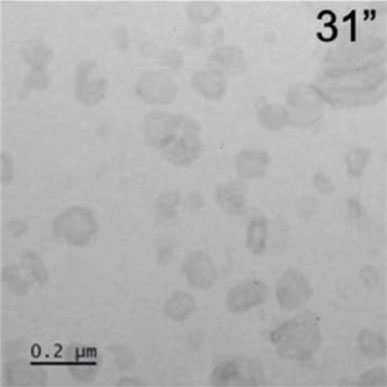
Micrographs showing crystals forming from flufenamic acid and growing into hexagonal crystals. A 0.2-micrometer scale is used for reference.

Wider Importance

It is at this earliest stage of growth that molecules can exhibit polymorphism; crystal structures that are composed of the same molecules but have different physical arrangements. Understanding how different crystal structures form from the same molecule type is desirable for research that needs nanoscale precision. For example, crystals are commonly used in medicines as a way to deliver active chemicals.

The antiretroviral drug, Ritonavir, which is used to treat HIV/AIDS, was pulled from circulation after it was found to contain a polymorphed version of the active drug. The polymorphed form was less biologically active and did not work as intended. Understanding these early steps in crystal growth is key to fine-tuning processes such as drug delivery.

Future Research

Advances in film technology and TEM allowed for direct observation of the nucleation process and this research represents the potential progress in the field of crystallisation. The results indicate that, with more research, scientists can discern the initial phases of crystal growth. This new technique opens up the field of TEM to visualising other crystallisation pathways, interrogate nucleation mechanisms, and explore new innovations.

The research was part of an EU Horizon 2020 FET-Open project named MagnaPharm which focuses on the magnetic control of polymorphism in pharmaceutical compounds. The team, which includes Dr Ursel Bangert and Dr Simon Hall, intend to continue to characterise flufenamic acid and different growth outcomes under different concentrations.

Learn more about our latest LPEM system ‘Stream’:

Discover more publications made possible by our Ocean system:

Read the original article:

Do you want to receive great articles like this in your mailbox? Subscribe to our newsletter.

Installing the first Climate system in Australia at the University of Sydney

Installing the first Climate system in Australia at the University of Sydney

Standing next to the recently installed Climate G+ system: from left, Keita Nomoto, Lizhuo Wang and Dr. Hongwei Liu from the Australian Centre for Microscopy & Microanalysis

Recently, we celebrated the installation of the first Climate G+ system ever in Australia. For this event we interviewed Dr. Bhatia at the Australian Centre for Microscopy and Microanalysis that oversees the Sydney Microscopy and Microanalysis core research facility at the University of Sydney. Earlier, he was key in the decision to purchase the world’s first Lightning STEM stage which established his relationship with DENSsolutions and ultimately lead to the installation of the Climate G+ In Situ TEM platform.

In this interview, we discussed the research needs of his facility and how they will benefit from the solutions designed and manufactured by DENSsolutions.

Can you tell us a bit about Sydney Microscopy and Microanalysis?

Sydney Microscopy and Microanalysis is the central microscopy facility at the University of Sydney. The University of Sydney is Australia’s first university and regularly ranks in the World’s top 50 universities.

We are a multi-user facility that services both the entire university as well as people from across Australia through the Microscopy Australia access scheme. Microscopy Australia provides access to member universities throughout Australia.

This means that we need to provide highly reliable, flexible solutions as we offer our instruments to users with a broad range of applications and skill levels.

Can you give us some examples of applications that your users are involved in?

Our researchers interests are many and varied. Some of the areas that are relevant to the new Climate system include:

  • Hydrogen generation
  • Methane breakdown as a consequence of global warming
  • Environmental corrosion of metals

It is hard to know what projects it will be used for as many users haven’t even presented themselves yet. But that is the point of buying versatile equipment.

In Australia, it is normal for funding for large equipment purchases to come from research grants. Can you tell us who won the grant to acquire the Climate?

A team from the Chemical Engineering Department working on catalysts were responsible for the bulk of the funding. Their contributions from their grant were topped up by the Australian Centre for Microscopy and Microanalysis (ACMM). ACMM supports the operation of the Sydney Microscopy and Microanalysis facility.

What features of the Climate attracted you to this particular system and how do you see the DENSsolutions in situ system benefitting your research?

As a core facility working with researchers from a range of different fields we needed a system with flexibility to cater to their different interests.
Other features of the Climate that that we found attractive were the ability to interchange parts and the ease with which individual components could be replaced. The ability to perform dynamic mixing of gases provided an added degree of versatility.
All these factors contributed to what we considered to be a future-proof design that best suited our facility and the range of potential experiments of our users.
The ability to investigate dynamic processes and to be able to observe these processes in real-time was also important to us. By being able to observe the entire process takes any guesswork out of the equation and means that we don’t miss any critical steps where changes might occur.

How popular has the system been to date?

The system was only installed in November. So far, we have only had three operators and a technician trained, bearing in mind the Christmas, New Year break. We do however intend to train more operators in the near future and can see the Climate being an important research tool.

In your experience so far, how have you found the Climate system?

The installation process was quite straightforward.
The fact that the software uses the same platform as the Lightning system that we already have abbreviated the familiarisation process. The software itself is very easy to use and the system as a whole is very intuitive.
We have only performed some basic measurements so far, but are looking forward to getting into some detailed experiments in the near future.

Learn more about our Climate system and Nano-Reactor:

Discover publications made possible by our Climate system:

Do you want to receive great articles like this in your mailbox? Subscribe to our newsletter.

1st Climate holder delivers new research results at FHI Berlin

1st Climate holder delivers new research results at FHI Berlin

Original article by Milivoj Plodinec, Hannah C. Nerl, Frank Girgsdies, Robert Schlögl and Thomas Lunkenbein. Published in ACS Catalysis.

In January 2016 DENSsolutions installed the 1st Climate holder with serial number #001 at FHI Berlin. The users at that time, Dr. Marc Willinger and Dr. Ramzi Farra, have since moved on to other institutes where they continue to use the Climate system for their research. In the mean time at FHI Berlin, new users took over the In Situ research activities and are producing excellent results with holder #001 which has since been upgraded with an EDS compatible tip.

Click here to read their recent publication in ACS Catalysis. The article demonstrates the stability of the Climate holder and Nano-Reactor. It also demonstrates the compatibility with other techniques like SAED and Mass Spectroscopy. By correlating all the data from these in situ experiments the mysteries of catalytic processes at the nanoscale will be unraveled!

“It was the combination of the DENSsolution Climate gas cell TEM holder with our homebuilt gas feed and analyzing system that enabled us to assign different parts of chemical dynamics of Pt catalyst to different activity regimes during CO Oxidation. The high sensitivity of our gas feed and analysing system ensured the detection of conversion, while the software and MEMS chip provided by DENSsolution ensured the stability over two weeks to perform experiment, even at extreme temperatures (up to 1000°C) for several hours.”

Dr. Milivoj Plodinec
Postdoc

Dr. Frank Girgsdies
Staff scientist

Dr. Thomas Lunkenbein
Group leader

Learn more about our Climate system and Nano-Reactor:

Discover more publications made possible by our Climate system:

Read the original article:

Do you want to receive great articles like this in your mailbox? Subscribe to our newsletter.

Driving the field of LPEM forward at the Gordon conference

Driving the field of LPEM forward at the Gordon conference

Last month, our Stream Product Manager Gin Pivak, CTO Hugo Perez and Microsystems Engineer Tijn van Omme visited the Gordon Research Conference (GRC) on Liquid Phase Electron Microscopy (LPEM). They were there to inform the LPEM community about our Stream system which allows researchers to introduce an accurate and controlled liquid environment combined with in-situ heating or biasing possibilities.
We realized that most researchers were still assuming that all liquid holders for LPEM are still relying on the ‘bathtub’ style (i.e. pocket structure where the 2 chips are placed). This is far from ideal, as the liquid bypasses the nano-cell and it only flows towards the window by diffusion in a non-controlled and spontaneous way. Therefore, it was a big relief for the LPEM community to learn that our Stream system now enables the real benefits, like (a) accurately controlling pressure and flow over the window, (b) controlling membrane bulging (i.e. controlling the liquid thickness) to enable higher resolutions, (c) enabling meaningful results in structure determination and analytical microscopy studies (e.g. EDS, EELS, electron diffraction), (d) controlling and mitigating bubble formation and most importantly, (e) reproducible experiments.
The Gordon Research Conferences are a special type of conference aimed at advancing frontier research. The idea is to bring all the relevant people in the field together to discuss and present (unpublished) results and to talk about the future directions of the field. All the major players in the field were present, and there was a lot of time for interaction. This created an open atmosphere, in which knowledge was shared and collaborations were established.
It became clear that the Liquid Phase Electron Microscopy community is maturing. LPEM offers a unique way for scientists to obtain information within a wide range of fields, including nanoparticle synthesis, self-assembly, corrosion, batteries, semicon, proteins and cells. However, compared to Cryo-EM, the field is still in its early days. A number of challenges still exist before results will be reproducibly accepted by non-microscopist communities. For example how to deal with the influence of the e-beam and how to control other influencing parameters.

‘Bathtub’ style LPEM system. Liquid bypasses the Nano-Cell and flows toward the window in a non-controlled and spontaneous way.

DENSsolutions Stream LPEM system. On-chip microfluidic channel enables full control over the liquid flow and pressure, thus the liquid-sample interaction.

On the first day of the conference, our CTO gave a presentation about the Stream Liquid Biasing and Liquid Heating system which resonated well amongst the attendees. The on-chip microfluidic channel in combination with the pressure control in the Stream system aligns well with the current and future demands of the field, as it enables control over the flow and liquid layer thickness.

Thank you for reading

To learn more about our LPEM system:

Do you want to receive great articles like this in your mailbox? Subscribe to our newsletter.